


The 24/48 vs. 48/96 firefighter schedule debate has been running through fire administration for years, and it has picked up considerably as more West Coast departments make the switch to 48/96. According to OHSU research tracking alternative schedule adoption, the number of departments that moved to schedules providing three or more consecutive days off grew from 65 in 2015 to more than 300 by 2021. The quality-of-life case for four consecutive days off is real, and firefighters at departments that have made the switch largely prefer it.
What the conversation often skips is the specific operational condition the 48/96 introduces that the 24/48 does not carry. Firefighters on a 48/96 spend two consecutive 24-hour tours on duty before going home, and how that second night plays out depends almost entirely on call volume. Departments that skip that analysis before committing to the schedule change tend to build nap policies and fatigue protocols after the fact rather than before.
The 24/48 keeps more crews cycling through the rotation continuously, which produces a deeper available pool for callbacks, more flexibility on short-notice vacancy fills, and less disruption to minimum staffing when a crew member goes out on extended leave or workers' comp. Because the off-period is shorter and crews return to duty more frequently, the callout list exhausts more slowly and the path to minimum staffing on any given day is shorter.
Firefighters on a 24/48 report to the station roughly eight to ten times per month. That frequency creates more regular opportunities to train, maintain apparatus, and build the crew cohesion that matters on the fireground. For newer crew members, working more regularly also means faster familiarity with their district and the rest of their crew, which translates to better coordinated response in departments where call volume is high and every rotation on the apparatus counts.
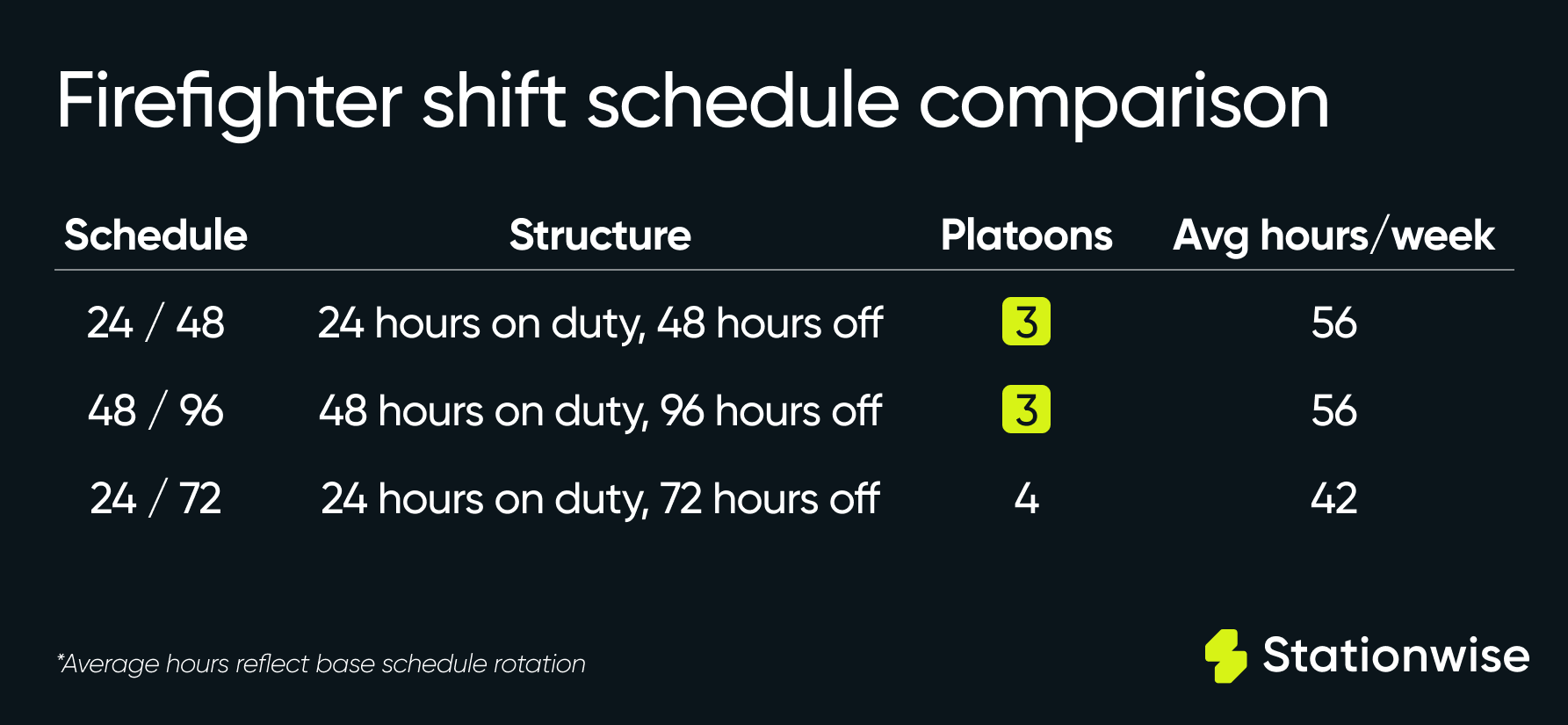
The 24/48 keeps the same three-platoon structure that 48/96 uses, so the choice between the two isn't a personnel cost question. It's an operational one. For departments where the primary staffing challenge is coverage consistency, or where call volume is high enough to make a second consecutive overnight difficult to manage safely, the 24/48 remains the right operational model.
Most departments approaching the 48/96 expect overtime savings that the schedule does not deliver. The 24/48 and the 48/96 average roughly 56 hours per week, which means their FLSA cost profiles are nearly identical. Both schedules approach the 212-hour threshold during a standard 28-day work period at about the same rate. The financial case for the 48/96 rests on what four consecutive days off produces for crew recovery, retention, and quality of life. For a deeper breakdown of how each schedule maps to overtime and budget exposure, this post on the full cost of firefighter scheduling runs through the math.
Firefighters on a 48/96 report to the station five to six times per month rather than eight to ten. Fewer commutes, longer uninterrupted time at home, and a recovery window substantial enough to support genuine physical and physiological reset between tours are the practical outcomes. Departments seeing early separations from firefighters who are worn down, difficulty attracting candidates who are weighing career sustainability against the grind of short recovery windows, and chronically low voluntary overtime participation are often describing conditions that a longer off-period directly addresses. Crews who are adequately rested will pick up extra shifts voluntarily, and that voluntary participation brings mandatory overtime spend down over time, a cost offset that rarely gets included in the initial budget analysis but shows up clearly once the schedule has been running for a full fiscal year.
A 2024 study published in PMC followed a department through a transition from 24/48 to 48/96 and found significant improvements in total sleep time, sleep efficiency, and depressive symptoms at both three and six months post-transition. Insomnia severity also declined, though more gradually, with the change only reaching statistical significance by the six-month mark. Those gains held after adjusting for call volume, years of service, and age. By three months, average total sleep time per tour had increased by roughly 23 minutes, and sleep efficiency had climbed three to four percentage points. Those are modest numbers individually, but the same research suggests they compound across a career, producing a more meaningful improvement in long-term recovery than the per-tour figures suggest on their own. For more on how departments can track crew health beyond annual physicals, this piece covers the health metrics worth monitoring.
The second consecutive 24-hour tour is the defining operational variable of the 48/96, and call volume is what determines whether that second tour is manageable or a genuine safety concern. A 2005 analysis by Dr. Susan Koen, which fire service scheduling research has cited widely, mapped this relationship clearly. Departments where crews average one or two calls a night generally don't see the negative effects of sleep deprivation play out. Three or more calls a night is a different story, with crews likely too sleep deprived by the end of the first 24-hour tour to work safely and effectively through a second one.
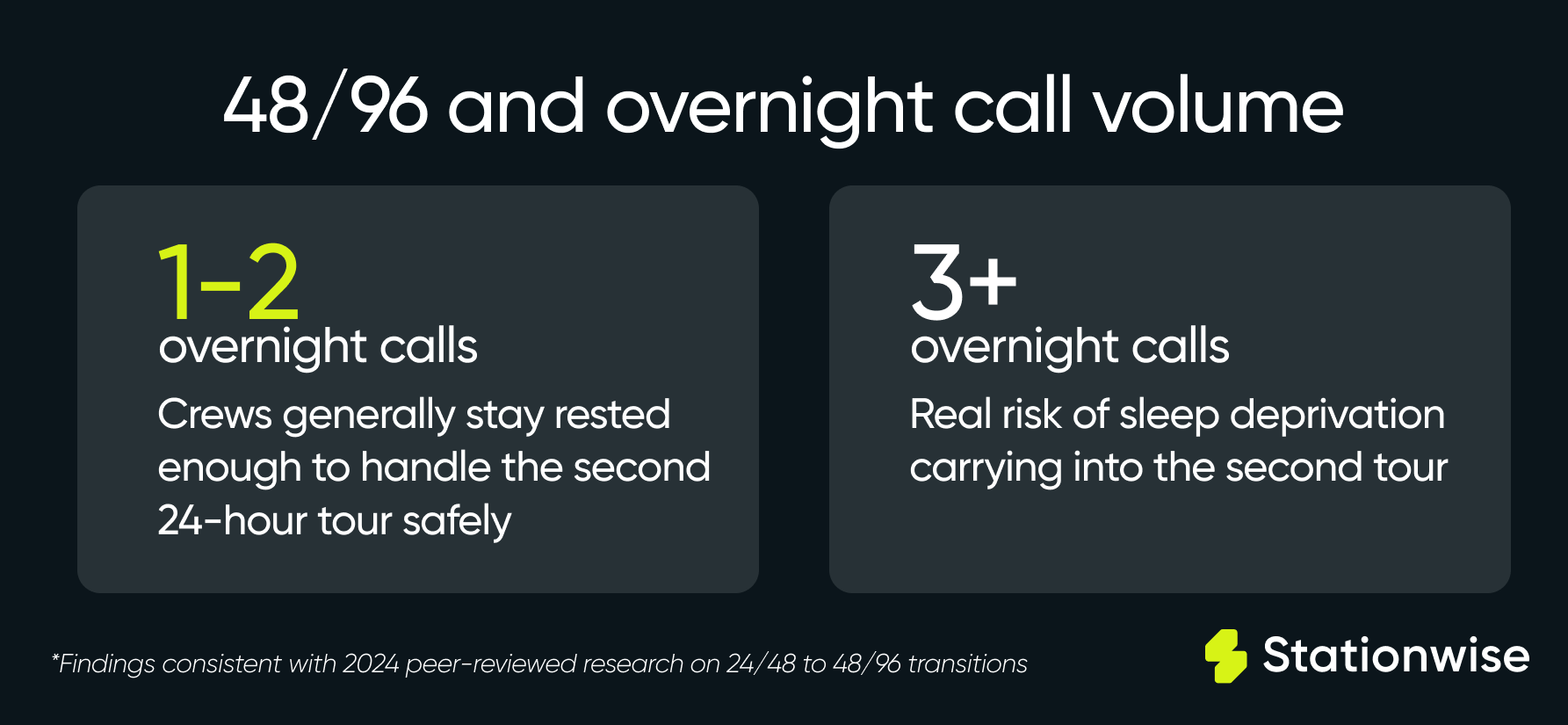
For a low-to-moderate call volume department, the 48/96 delivers what it promises. At a busy urban engine company averaging four or five overnight calls, the second night creates a fatigue problem that four days off cannot fully undo, and departments that make the switch without accounting for their overnight call frequency by station and by apparatus are the ones that end up managing the consequences through mandatory rest policies rather than through schedule design.
The 2024 PMC transition study reinforced this directly, noting that its positive findings applied to a lower call volume department and may not generalize to higher volume settings. The researchers specifically flagged higher call volume departments as an area the existing research has not yet fully addressed, which means departments in that range need to think carefully before treating that study's outcomes as a reliable preview of their own results. Average overnight call frequency is available through incident reporting data and is worth pulling before the schedule conversation gets too far along.
The 24/48 produces more frequent vacancy fills and higher callback volume. Because crews return to duty every third day, the staffing roster turns over quickly and vacancies surface more often. More callbacks means more callout list management, more certification matching, and more shift trade processing across a shorter cycle. The administrative load that creates is real, and in departments where it falls on a battalion chief who is also running the 0700 shift change, it adds up fast.
The 48/96 reduces vacancy fill frequency but introduces its own complications. With crews off for four consecutive days, callback lists can exhaust faster during extended vacancy periods, and the staffing window between a crew finishing a 48-hour tour and their next availability is longer. On a 48/96, shift trades carry significantly more weight than on a 24/48. Trading a 48-hour tour is a more significant commitment than trading a single 24-hour shift, which changes how often crew members initiate trades and how complex the certification-matching and hours-balance reconciliation becomes on each one. The payroll logic around a 48-hour tour, including how acting pay, specialty pay, and overtime code assignments apply across a two-day block rather than a single shift, requires scheduling systems that handle that configuration reliably without manual intervention at each step. Payroll errors on schedule transitions are most common precisely in this window, when departments are running new tour structures through systems built for the old ones.
Departments that move from 24/48 to 48/96 without updating their scheduling infrastructure often discover that the administrative logic built around single-tour assumptions does not translate cleanly to a two-tour structure. Stationwise handles position auctions, callback list management, and payroll code assignments specific to 48-hour tour structures natively, which means the administrative complexity of the transition does not land on whoever is managing the roster by hand.
Departments evaluating a move to 48/96 sometimes carry over a cost assumption that belongs to a different schedule entirely. A 24/72 needs a fourth platoon, because covering continuous duty on a four-day cycle takes four crews instead of three, and that fourth crew is where the 33% personnel increase and the 42-hour average workweek both come from. The 48/96 doesn't share that structure. Three platoons running 48-hour tours instead of 24-hour tours cover the same six-day cycle with the same headcount and the same 56-hour average, which is why the FLSA exposure barely moves between the 24/48 and the 48/96.
That distinction matters in a city council room. Treating 48/96 like it carries the same personnel cost as 24/72 can derail a proposal that the budget never actually needed to absorb, since the new-hire line item the chief prepared to defend isn't real. The real financial case for 48/96 looks more like a clean upside than a tradeoff. Departments keep the same headcount and the same base pay, and pick up a schedule that the research in the previous section associates with measurable improvement in sleep and depressive symptoms, the kind of voluntary overtime participation that reduces overtime spend without adding headcount, and the retention benefit that often gets overlooked when the conversation stays fixed on the personnel line.
That doesn't make the move free. Departments still take on the administrative cost outlined above, the payroll reconfiguration, the new position auction structure, the recalibrated callback lists, and whatever CBA negotiation the schedule change requires. Those are real costs, they just aren't personnel costs, and treating the two as the same thing is what leads departments to either overstate the budget ask or get caught off guard when the actual cost shows up somewhere else.
The 24/48 and 48/96 serve different operating conditions, and call volume is the variable that most clearly separates the departments where each one fits. A lower call volume department with a retention problem and crews who are chronically worn down is running a different analysis than a busy urban engine company where a second overnight tour would worsen fatigue that four days off cannot fully undo.
Completing that analysis before the conversation with city leadership or the union gets far enough to be difficult to reverse means accounting for overnight call frequency by station and by apparatus, the fully loaded cost of what chronic fatigue is already spending in sick leave, workers' comp, and turnover, and the administrative infrastructure that has to support whichever schedule the department runs.
Book a demo to see how Stationwise handles 48/96 configuration, including position auctions and callback list management, for departments evaluating where they stand.