


Co-authored by Marcus Edwards and the Western Fire Chiefs Association
The fire service has enough bad vendor experiences to fill a conference room. Chiefs who have been through a failed implementation know what it costs the department, and that history makes the next procurement harder before it even starts.
The departments that get technology transitions right tend to share a common set of practices that show up at every phase of the vendor relationship. Those practices are learnable.
The Western Fire Chiefs Association and Stationwise recently brought together Fire Chief Paul Dow of McKinney Fire Department, technology strategist Joanna Zibbell, and Marcus Edwards, CEO and co-founder of Stationwise to talk through what those practices actually look like. What follows are the lessons from that conversation.
Before a technology transition begins, the most important work a chief can do has nothing to do with the software itself. It starts with the people whose sign-off will determine whether the project moves forward or stalls. IT, legal, finance, and labor all need to be in the conversation from the start. When they arrive late, they arrive with complications that slow the whole process down.
Chief Dow came into the Stationwise selection process having already been through a previous staffing software that didn't work for the department. One of the clearest takeaways was the working group. He built one that mixed people from the admin side and the operations side, because what the command staff needs from a staffing system and what the crew running calls needs from it are both real, and both have to be accounted for.
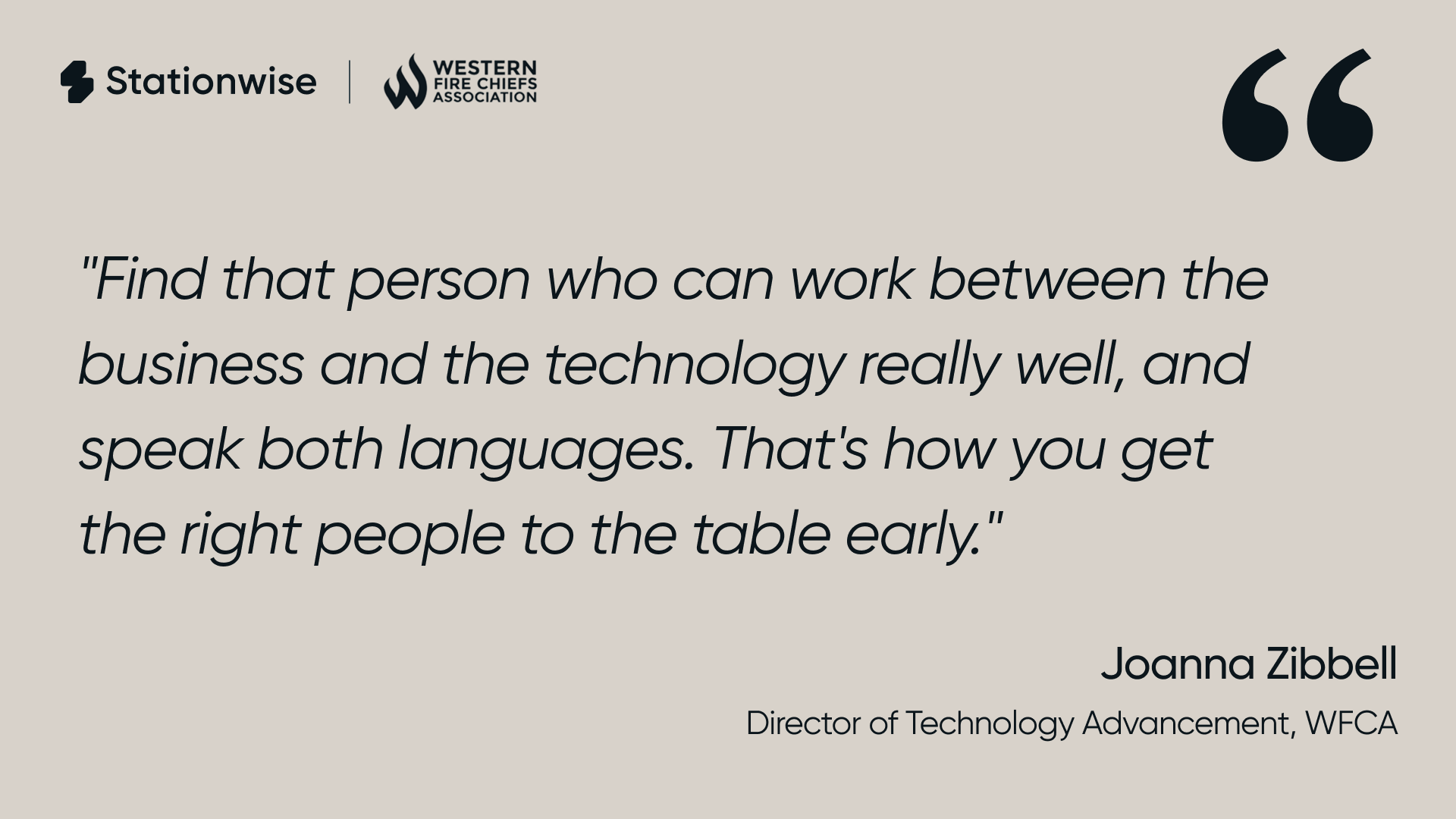
Joanna Zibbell, Director of Technology Advancement at the Western Fire Chiefs Association, sees this pattern across the Western's 2,800 member departments. Not every department has the luxury of a dedicated technology manager, but every department has someone who can sit between the operational and technical worlds and speak both languages. Finding that person and putting them at the table before procurement starts pays off at every stage that follows.
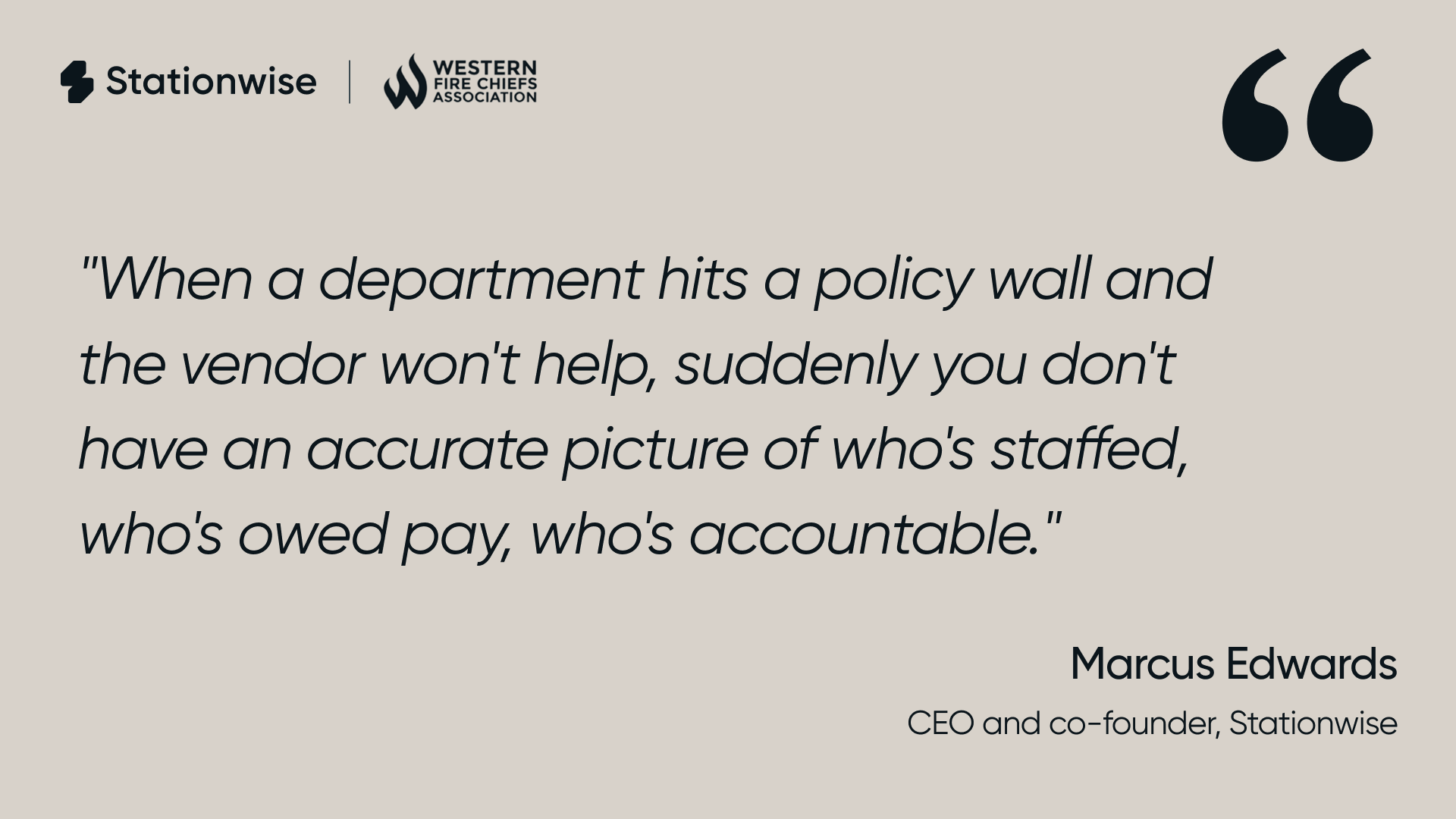
Policy is behind almost every custom feature request a vendor receives. And fire departments, with their union agreements, FLSA obligations, and department-specific pay structures, tend to arrive at implementation with policies that are layered, specific, and not always easy to change. The responsibility when a department hits a wall between its existing policy and what the software can do sits primarily with the vendor. In about 90% of cases, the answer is on the vendor side. A vendor that refuses to engage with a legitimate policy constraint does not just slow the implementation down. It creates a workflow that disenchants the people doing the work and leaves data scattered across workarounds, which means the chief loses an accurate picture of who is staffed, who is owed pay, and who is accountable.
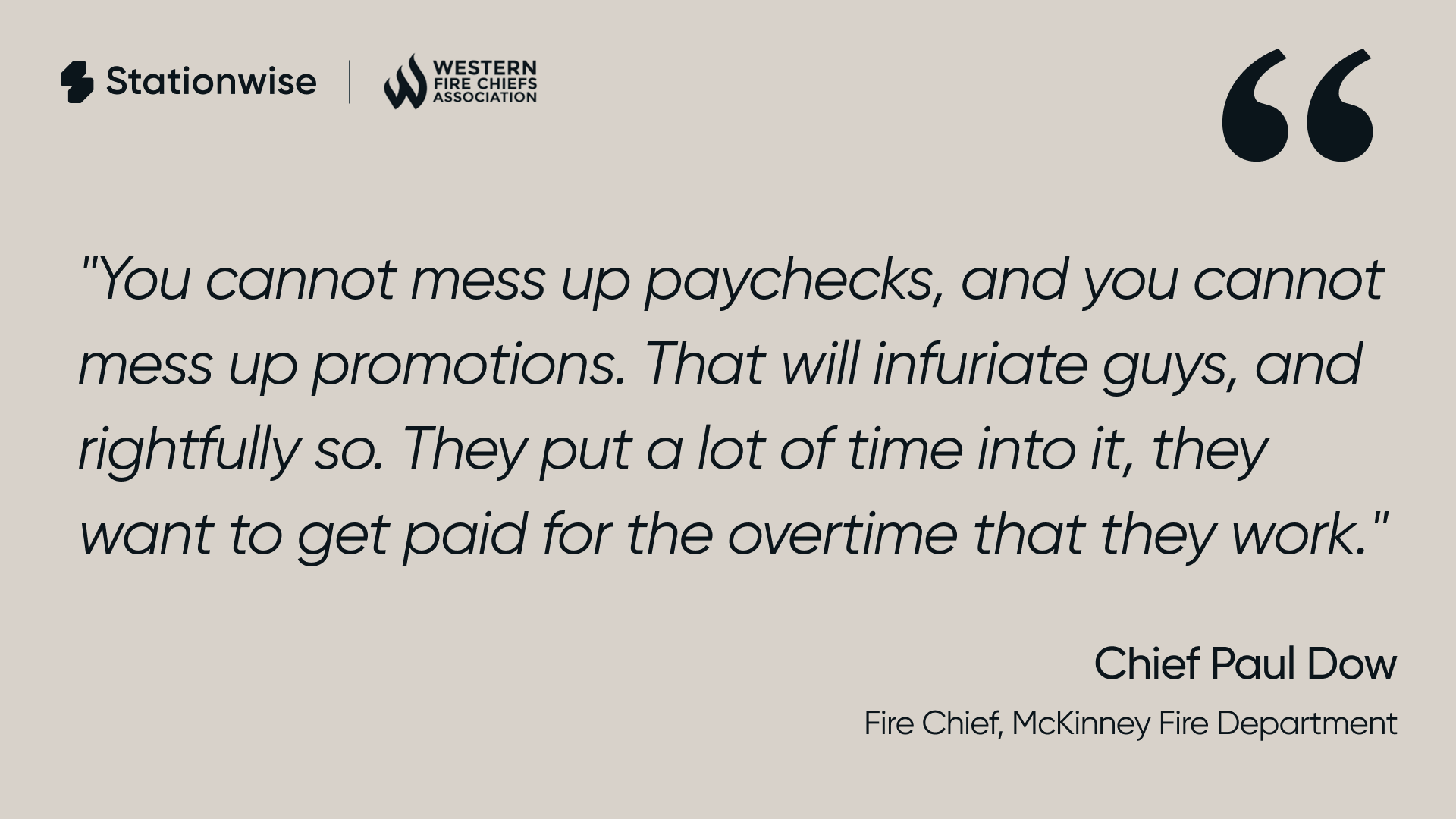
The other 10% involves situations where there genuinely is a simpler approach, and a good vendor surfaces that by showing what other departments do. That is what happened at McKinney. As the department grew, overtime coding had accumulated complexity that worked at a smaller scale but created problems at a larger one. Stationwise was straightforward about it. They told Chief Dow his team was making it more complicated than it needed to be, showed him how other departments handle the same scenario, and explained what the benefit of simplifying would look like. The conversation was easy. It moved quickly through small group meetings with battalion chiefs and then to labor management, and it landed without resistance because McKinney already had a strong relationship with their association.
Bringing labor along through a technology transition is a relationship problem before it is anything else. Chief Dow kept the Stationwise integration and its associated policy changes on the agenda at every regularly scheduled labor-management meeting throughout the process. Nothing landed as a surprise because he made sure labor was part of the conversation from the start. From the very beginning, he was upfront with the association that changes were coming and that he was looking for their feedback to shape how those changes were made.
When specific policy questions came up, he gave the association a draft copy, time to take it back to the executive board and talk to other members in the organization, and a genuine opportunity to help identify the landmines before the process moved forward. His advice on pace is simple. Go slower than you think you need to. At some point a decision has to be made, but the goal is to get there with labor fully informed, not to get there fast.
Before signing anything, the question worth asking every vendor is one Chief Dow now shares with every chief he talks to. Ask what the vendor does well. That is usually easy for them to answer. Then ask what they are currently struggling with. A vendor that says they have no current challenges is not being straight, and opening that honest dialogue early gives a department a much clearer picture of what the relationship will actually look like.
There is also the question of who a department is actually talking to during the sales process. There is almost always a handoff from the people handling sales to the people handling implementation, and often another handoff from implementation to whoever manages ongoing support. The sales team will be the most energized group a department ever meets from that company. Getting clarity on what every phase of the process looks like, and meeting the implementation team before signing, gives a department a much stronger foundation going in.
Most fire departments have been burned by a vendor at some point. Chief Niemeyer has watched this play out across 15 years as a fire chief and across the Western's membership. A vendor says yes to everything during the sales process, gets the department implemented, and then becomes unreachable six months later. Building trust with a vendor requires more than taking their word for what they can do.
His practical advice is to ask vendors what they cannot do just as much as what they can do. Finding out where a vendor's limits are before the contract is signed gives a department a much clearer picture of what the relationship will actually look like. And when a vendor makes a specific claim about what their software can do, the RFP or RFQ process is the right moment to make them show it working, not describe it.
The Western Fire Chiefs Association's work with vendors does not stop at endorsement. Joanna described the active role WFCA plays in holding vendors accountable across its membership, establishing what good looks like, sharing what to watch out for, and giving departments the collective knowledge they would not have working alone. The fire service's greatest asset in vendor relationships is the community itself. A department navigating a difficult implementation is rarely dealing with something no one else has faced before.
What Joanna brings to that community is a perspective built from years spent on both sides of the table. When Chief Niemeyer asked whether failed implementations come down to bad vendors or departments that didn't set the right parameters, she pushed back on the premise. Both sides carry responsibility, and the relationships that work well are the ones where both sides show up with genuine empathy for what the other is carrying.
The full conversation is available to watch on YouTube. This webinar is part of an ongoing series from the Western Fire Chiefs Association and Stationwise, bringing together fire service leaders to share what they have learned navigating technology in the fire service.