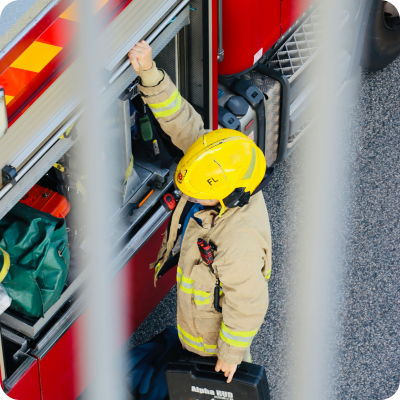



I grew up in a firefighting family. My dad, his dad, and two uncles all served. We celebrated holidays when family members were off shift, not based on the calendar. From early on, my life ran on a 24/48 schedule without me ever having chosen one. The schedule shaped meals, holidays, sleep, and the rhythm of our home.
When I started talking to fire chiefs before building Stationwise, I already understood something about what a shift schedule actually does to a life. One pattern kept showing up. The chiefs who were most worried about their budget were spending most of it on overtime and workers' comp. The chiefs who were most worried about their people were watching experienced firefighters burn out, get injured, or leave before they hit twenty years. Nobody was treating those as the same problem.
When a firefighter goes out injured, the department doesn't absorb one cost. The vacant slot gets filled with overtime, usually mandatory. If the injury runs long enough, the department eventually brings in a full-time backfill with benefits, someone who will also earn overtime when the normal staffing gaps arise. Meanwhile, the injured firefighter is working through workers' comp and possibly disability. A single injury cascades across multiple budget lines over months, sometimes years.
A 2023 study analyzing workers' compensation claims among Washington State firefighters from 2006 to 2020 found that the mean cost of a single lost-time case was $46,318, covering medical care, indemnity payments, and anticipated future costs. That figure doesn't include the overtime spent filling the vacant slot, the productivity loss during recovery, or what happens to retention when mandatory overtime becomes typical practice on a crew that's already short.
Fire departments are absorbing these costs constantly. Most are not tracking them as a connected picture. Overtime sits in payroll, workers' comp in HR, injury patterns in safety logs, and sick leave somewhere else entirely. The schedule that drove all of those costs sits outside the frame.
In July 2022, the International Agency for Research on Cancer, the cancer agency of the World Health Organization, reclassified firefighting as a Group 1 carcinogen, putting the profession in the same category as tobacco and benzene. The evidence was sufficient to conclude that firefighting causes mesothelioma and bladder cancer, with limited evidence for several additional cancer types. Firefighters already face a 9% higher rate of cancer diagnosis and a 14% higher cancer death rate than the general population.
The schedule is part of what makes those numbers worse. A survey cited in the IAFF's white paper on shiftwork found that 60% of firefighters only get short bursts of sleep during shifts, and 40% report feeling excessively fatigued. Chronic sleep deprivation over a career raises the risk of cardiovascular disease, obesity, and cancer, all conditions that already show up at elevated rates in the fire service. A body running that kind of sleep debt across a 25-year career becomes progressively less resilient to the occupational exposures that come with the job.
Most fire chiefs know the cancer data. Few have traced it back to the shift schedule sitting on the whiteboard at the station.
The conversation about schedule reform in the fire service almost always starts with cost. Fire departments say the 24/72 schedule costs more because more people are needed to cover the same number of stations. Nobody is disputing that number. What rarely gets calculated is everything on the other side of the ledger.
Departments that move to longer rest cycles often see mandatory overtime decline. Firefighters who are adequately rested will pick up extra shifts voluntarily for the pay. The overtime moves from mandatory callouts that nobody wants, which add to the fatigue cycle and carry real retention consequences, to voluntary pickups that people choose. In my conversations with fire chiefs across the country, this is one of the patterns that shows up consistently once a department has been on a longer rest cycle long enough to see it.
Add to that the workers' comp claims that go unfiled, the sick leave that goes unused, and the experienced firefighters who stay long enough to actually retire. None of those savings show up in a budget projection for schedule reform because nobody has built the model that connects them. The costs of staying on the current schedule are real and ongoing. They are just scattered across enough line items that they never get added up.
Most departments do not have a way to see this full picture because the information does not live in one place. The data that would connect scheduling decisions to their downstream health and budget consequences is scattered across payroll, HR, safety logs, and finance systems that were never designed to talk to each other.
That is the gap we are working to close at Stationwise. Over the past year we have been building health tracking capabilities in close partnership with advisors who have spent years collecting wearables data and health records across dozens of departments. The goal is to make this picture visible inside the day-to-day workflow, where it can actually inform a decision.
The data exists or can be collected. The model that ties it all together does not yet exist at scale, and that is the problem worth solving.
Budget season runs from January through April for most fire departments. That window has closed, but the numbers don't stop accumulating. Pull your overtime spend, your workers' comp claims, and your sick leave data and put them in the same room. Ask what they have in common. The answer will say more about your department's health than any annual physical report, and more about your overtime problem than any staffing consultant.
The fire service has been having the health conversation and the budget conversation separately for a long time. They are the same conversation, the same problem. The schedule sits at the center of both, and until departments start treating it that way, the costs will keep showing up in the wrong columns.