


Section 207(k) of the FLSA (Fair Labor Standards Act) gives public agency fire departments a different overtime framework than virtually every other employer in the country. Departments elect a work period of 7 to 28 consecutive days and owe overtime only when hours in that period exceed a proportionate threshold. For a 28-day period, that threshold is 212 hours.
The guidance written to explain this framework addresses individual firefighters almost exclusively, covering tax deductions under the federal overtime law that took effect in 2025, qualifying hours on a pay stub, and what employers are required to report. Fire chiefs and payroll administrators managing 207(k) compliance at the department level have almost no dedicated resources written for them.
Under the standard FLSA, overtime is owed after 40 hours in a workweek. Public agency fire departments operating under Section 207(k) work from a different foundation. Departments elect a work period of 7 to 28 consecutive days and owe overtime only when hours in that period exceed a proportionate threshold. For departments that have established a 207(k) work period through formal policy, the standard 40-hour rule is replaced entirely.
The thresholds for fire protection employees, sourced from 29 CFR Section 553.230 and confirmed against DOL Fact Sheet #8, break down by work period length.
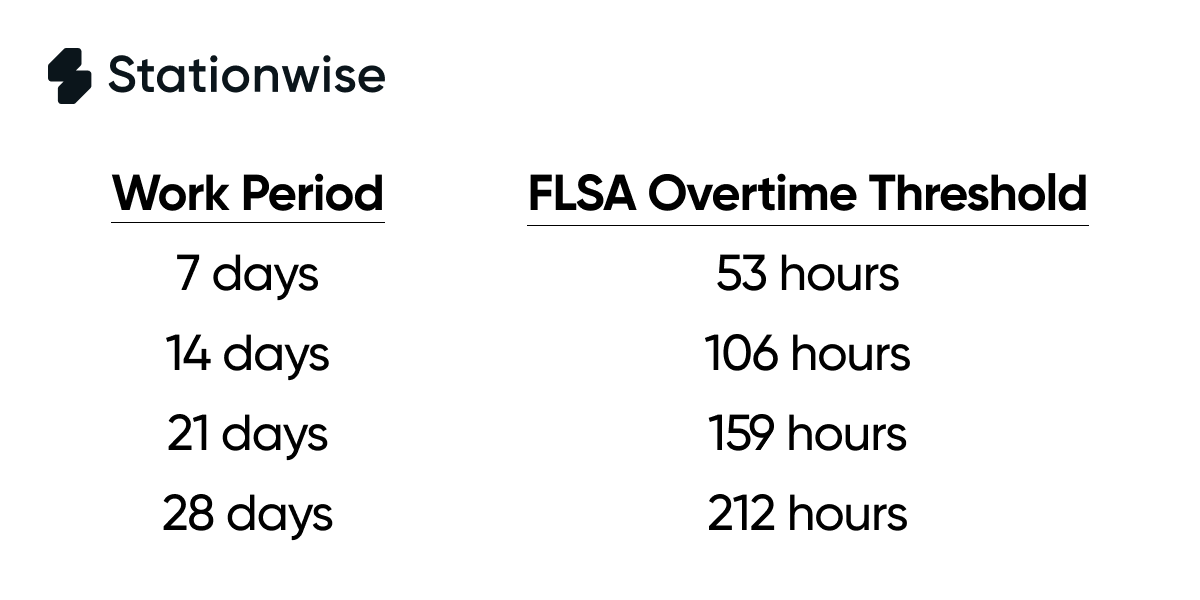
The work period length is a choice departments make, and it carries real payroll consequences. A department on a 28-day period does not owe overtime until a firefighter exceeds 212 hours in that period. A department on a 14-day period owes it after 106. That choice also determines how quickly a standard rotation approaches the threshold before any callbacks or additional shifts are added, which matters for how departments structure their scheduling and callout rules.
One point many departments have not fully addressed: 207(k) does not apply automatically. The work period must be established through a written department policy and applied consistently over time. Courts have found that departments without a formally documented work period can lose 207(k) status entirely and revert to the standard 40-hour weekly overtime rule, meaning overtime would be owed on hours currently treated as regular time. A department operating under the assumption that it has always been 207(k)-compliant, without documentation to support that assumption, is carrying legal exposure it may not recognize until a grievance or audit surfaces it.
The threshold number means different things depending on the schedule a department actually runs.
A 24/72 rotation is 24 hours worked out of every 96-hour cycle, which averages 42 hours per week and roughly 168 hours across a 28-day FLSA period. For a 24/72 department on a 28-day work period, overtime liability is triggered by callbacks and additional coverage. The standard rotation stays well under the threshold on its own.
The math is different for a 24/48 rotation. Twenty-four hours worked out of every 72-hour cycle averages 56 hours per week, or approximately 224 hours across a 28-day FLSA period. A 24/48 firefighter on a standard rotation can exceed the 212-hour threshold before any callbacks are added. That is the ordinary math of a 24/48 schedule on a 28-day FLSA period, and it is a core reason many 24/48 departments use Kelly days to reduce total hours in the period, or elect a 14-day FLSA period instead. At a 14-day threshold of 106 hours, a 24/48 department has a more workable calculation basis for a standard rotation.
Debit days are extra work days used by 24/72 departments in Washington and Oregon to bring average weekly hours back up to target. Kelly days are extra days off. Treating them as interchangeable changes the threshold math and produces payroll errors.
Collective bargaining agreements frequently require overtime at rates or thresholds beyond what the FLSA mandates, and the distinction between the two sources of obligation matters for how payroll is categorized.
If a CBA requires time-and-a-half pay for hours that are straight time under 207(k), that premium comes from the contract, not from a federal overtime obligation. That distinction has always mattered for payroll accuracy, and the federal overtime law that took effect in 2025 added a second reason to track it. Under the One Big Beautiful Bill Act, firefighters can deduct the premium portion of FLSA-required overtime from their federal taxable income. CBA-required overtime payments above that threshold do not qualify for the deduction.
Starting in 2026, employers must separately report FLSA-qualifying overtime compensation on W-2s. The IRS has detailed this requirement in a specific Q&A, and the Government Finance Officers Association has addressed it in guidance for public employers. A department whose payroll system combines CBA-required and FLSA-required overtime into a single code cannot produce that reporting accurately.
Acting pay adds another layer. When a firefighter covers an out-of-rank assignment, their rate changes, which affects the regular rate calculation used to determine the FLSA overtime premium owed for that period. This happens in any department managing acting assignments across a 28-day cycle, and it compounds across a pay period with multiple personnel moves.
The FLSA does not count hours taken as protected FMLA (Family and Medical Leave Act) leave toward the overtime threshold. The firefighters covering that vacancy do accumulate those hours, and one extended FMLA absence can push multiple covering personnel toward the 212-hour mark within a single work period. Departments without integrated leave and staffing tracking often do not see that accumulation until after payroll runs.
The 2026 reporting requirement surfaces complexity that departments were already managing without being required to document it.
Three practical conditions determine whether a department can manage 207(k) compliance and the 2026 reporting requirement with confidence. None of them require specific software, though all three are easier to sustain when the system a department runs on is built to support them.
A department that has always operated under a 207(k) election but cannot point to a written policy establishing it is carrying risk it may not recognize. The documentation does not need to be complicated. It needs to exist, specify the work period length, and be applied consistently. That written record is what protects the department if a grievance or audit questions its overtime calculations.
When the two run on different cycles, overtime hours are often not fully known until after payroll has already processed, which is when corrections become expensive. For departments on a 24/48 schedule with a 14-day pay period, aligning the FLSA period to match means overtime hours are known at the time payroll runs, without retroactive adjustments. This is the configuration Stationwise worked through with McKinney FD, where aligning FLSA and pay cycles eliminated the reconciliation problem the department had been absorbing under their previous system. Departments looking to reduce overtime costs more broadly often find that cycle alignment is the first step.
Beginning with the 2026 tax year, the IRS requires FLSA-required overtime and CBA-required overtime to be separately reportable on W-2s. A department that has not built that separation into its payroll system will need to reconstruct it from raw records at year-end. Payroll errors in fire departments most often trace back to exactly this kind of categorization gap, and the administrative burden of correcting them at year-end is entirely avoidable if the separation is built in from the start.
Stationwise tracks FLSA periods and pay periods as distinct inputs, assigns the FLSA and CBA overtime distinction at the pay code level, and sends alerts when hours are approaching the threshold so administrators see the issue before payroll runs, not after.
Departments that have treated 207(k) as a background condition they have always satisfied, without actively managing or documenting it, are the ones most likely to face payroll corrections after a complicated pay period, grievances over overtime distribution, and W-2s they cannot fully stand behind.
Before the 2026 reporting year closes, any department managing 207(k) compliance should be able to confirm three things. The work period is documented in writing and applied consistently. FLSA and pay periods are aligned, or managed on separate cycles with a clear reason for the difference. The payroll system can separate FLSA-required overtime from CBA-required overtime in a way that supports accurate W-2 reporting. Departments that cannot confirm all three have identified where the work is.
Book a demo to see how Stationwise tracks FLSA periods, pay codes, and overtime thresholds in real time.