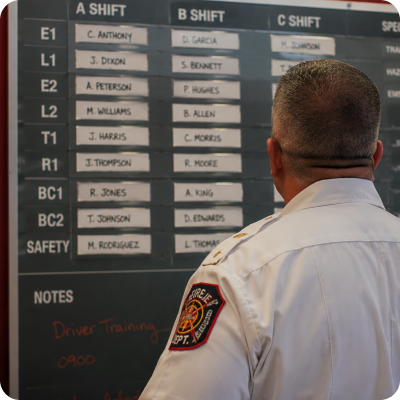



A scheduling system rarely fails all at once. It fails in pieces that don't look connected from inside a fire department, a pay code that comes back wrong three weeks after a callback shift, a shift trade that goes through without checking who's actually certified for the apparatus, a callout process that only the one person who used to run it ever fully understood. Fire departments log each of these as a one-off mistake, a staffing headache, or just a bad week. They're usually the same problem showing up in a different form, a system, whether that's an actual competitor platform or a whiteboard and a shared spreadsheet, that has stopped matching what the fire department needs it to do.
Recognizing that pattern matters more than the search for fire department scheduling software, because a fire department that can't name what's actually broken evaluates the next system against the wrong criteria too. Five signs make the pattern visible before it costs a fire department a grievance or a hard budget conversation.
Fire departments rarely build their scheduling logic once. Union agreements, FLSA exemptions, and a rotating 24-hour shift pattern interact in ways a standard 9-to-5 workplace never has to reconcile, and each interaction is another place a side letter can attach itself. Side letters accumulate on top of the base agreement over the years, each one written to resolve one specific situation, a grievance that needed a documented resolution, a callback rule that needed clarifying for one classification, a pay code that needed a written interpretation nobody thought to build into the original agreement. Each addition made sense on its own, and nobody ever redesigned the base logic to account for the growing list of exceptions layered onto it.
The rules don't announce when they start contradicting each other. What happens instead is a battalion chief has to remember, before the 0700 shift change, which side letter overrides which default for which classification, because the system itself doesn't track any of it. When that memory is wrong, or that person is out, the resulting mistake shows up as a scheduling error, a pay correction, an isolated mix-up, each one logged and fixed without anyone tracing it back to the rules underneath. The tell is a category of mistake that keeps recurring in slightly different forms, with every fix landing as a manual patch instead of a change to the underlying logic.
This same failure mode is why firefighter payroll errors keep recurring long after go-live, a pattern covered in more depth here.
Every fire department running on a system that predates its current size has one, a payroll admin who's run the exports for a decade, a scheduler who's learned every workaround by trial and error and never had reason to write any of it down. Their knowledge of the workarounds keeps the schedule and the payroll accurate, more than the software or the spreadsheet does.
The risk surfaces the week that person is out for a family emergency, or the month after they retire, when the fire department discovers how much of what worked for years lived only in one person's head rather than anywhere the system itself could enforce. A fire department can be fully staffed on paper and still lose weeks of accuracy the moment one specific person stops being available. Headcount and system reliability are separate measurements, and losing the second one doesn't require losing any of the first. Few fire departments have ever mapped what that one person actually does beyond their job title, so the discovery tends to happen during the gap itself.
Losing that kind of institutional knowledge is a retention cost fire departments rarely account for, even when the person walking out the door isn't riding the apparatus.
A callback list and an eligibility list are two different things. Filling a vacancy safely means checking certification requirements, seniority order, and CBA-specified sequencing, voluntary before mandatory, for example, before anyone attaches a name to it. If that check depends on whoever is building the list remembering who's qualified for a specific apparatus that day, the system in use is functioning as a calendar, regardless of how digital the interface looks.
The gap surfaces at the worst moment, when a trade or callback assignment goes out to someone who isn't actually eligible, and the fire department finds out during a grievance rather than before the shift starts. An audit trail that shows every rule applied and every decision made before an assignment is what protects a fire department in arbitration. A callback process running on memory can't produce that record, because nobody wrote the reasoning down anywhere but in their own head. In a grievance hearing, a fire department defending a memory-based decision argues from a weaker position than a firefighter who remembers the specific instance clearly, regardless of whether the original call was right.
A system built to handle this checks certification and seniority automatically before a name ever reaches the list, so eligibility stops being something a battalion chief has to hold in their head at 0300. Whether the vacancy fills through a call-down list, an auto-hire bid, or a direct assignment, the rule applies the same way every time, and the record of why it applied shows up on its own instead of depending on someone remembering to write it down later.
Fire departments carry more payroll complexity than almost any other city function. More than 80% of a given city's pay codes belong to the fire department alone, and that complexity multiplies across FLSA work periods, acting pay, specialty differentials, and trades that all interact with each other. Under FLSA Section 7(k), fire departments calculate overtime against work periods of 7 to 28 days rather than a standard 40-hour week, and on a 28-day period overtime starts after 212 hours. Filling a single vacancy with the wrong person can push their hours toward that threshold without anyone noticing until the pay period closes. Fire departments typically manage that complexity across three separate records. The roster shows who's scheduled, timekeeping shows who actually worked, and payroll shows what it cost, and none of the three talks to the others in real time.
Answering a simple question, what a specific vacancy cost, or who else has the certification to cover it next time, shouldn't require pulling data from three places and reconciling it by hand. When that reconciliation is the only way to get an answer, and the answer isn't available until two to three weeks after a pay period closes, the delay itself is the sign. By the time the fire department can see what a decision cost, battalion chiefs are already making next month's overtime decisions blind.
A real-time staffing dashboard pulls the same numbers the roster, timekeeping, and payroll are each tracking separately into one place, updated as it happens instead of reconstructed two weeks later. A panel showing "6 of 8 staffed," the same panel a battalion chief checks at shift change, draws on the same pay code logic running underneath it, so the cost of a vacancy is visible the day it happens instead of the pay period when payroll finally corrects it.
Some systems look adequate simply because real growth has never tested them. A fire department that stays roughly the same size, with a stable roster and no major changes to its shift pattern or its CBA, can run a whiteboard or a basic spreadsheet for years without ever finding its limits. The limits were always there. Growth is usually what exposes them.
Fresno County Fire Protection District runs a custom 66-hour workweek that doesn't match any of the standard rotations, 24/48, 24/72, or Kelly day, most scheduling systems are built around, and needed a custom pattern editor built specifically to handle it. Building a schedule around a pattern like that takes a system flexible enough to define custom rules from scratch, matching the pattern to the fire department instead of the fire department to whatever the software already supports. The same pattern shows up when a fire department opens a new station, absorbs another agency, or moves several volunteer companies under one standardized structure. Each of those events asks a scheduling system to do something it wasn't originally built for, support a shift pattern that doesn't exist in its templates, reconcile staffing rules across agencies that never shared a rulebook, or apply one standard where several used to exist independently. An operation's specific needs outgrowing the assumptions a general system was built under is a normal, foreseeable transition, and it's usually the first time anyone notices those assumptions existed at all.
None of these five signs require a fire department to already be in crisis, that's the point of naming them. A rule quietly contradicting another rule, a callout list running on memory, a cost that takes three weeks to see clearly, these are recognizable before they turn into a grievance or a budget surprise. Fire departments that catch this early treat the system as something to evaluate on its own terms, before it breaks in a way nobody can ignore. The alternative is waiting for one of these five patterns to force the decision anyway, usually at a worse moment and with less control over the timeline.
A fire department that recognizes two or three of these signs already knows more than it might think about what to evaluate next. 7 Questions to Ask Every Fire Department Staffing Software Vendor covers what to ask once that evaluation starts. For a closer look at how Stationwise handles the rules, the trades, and the real-time picture described above, book a demo.