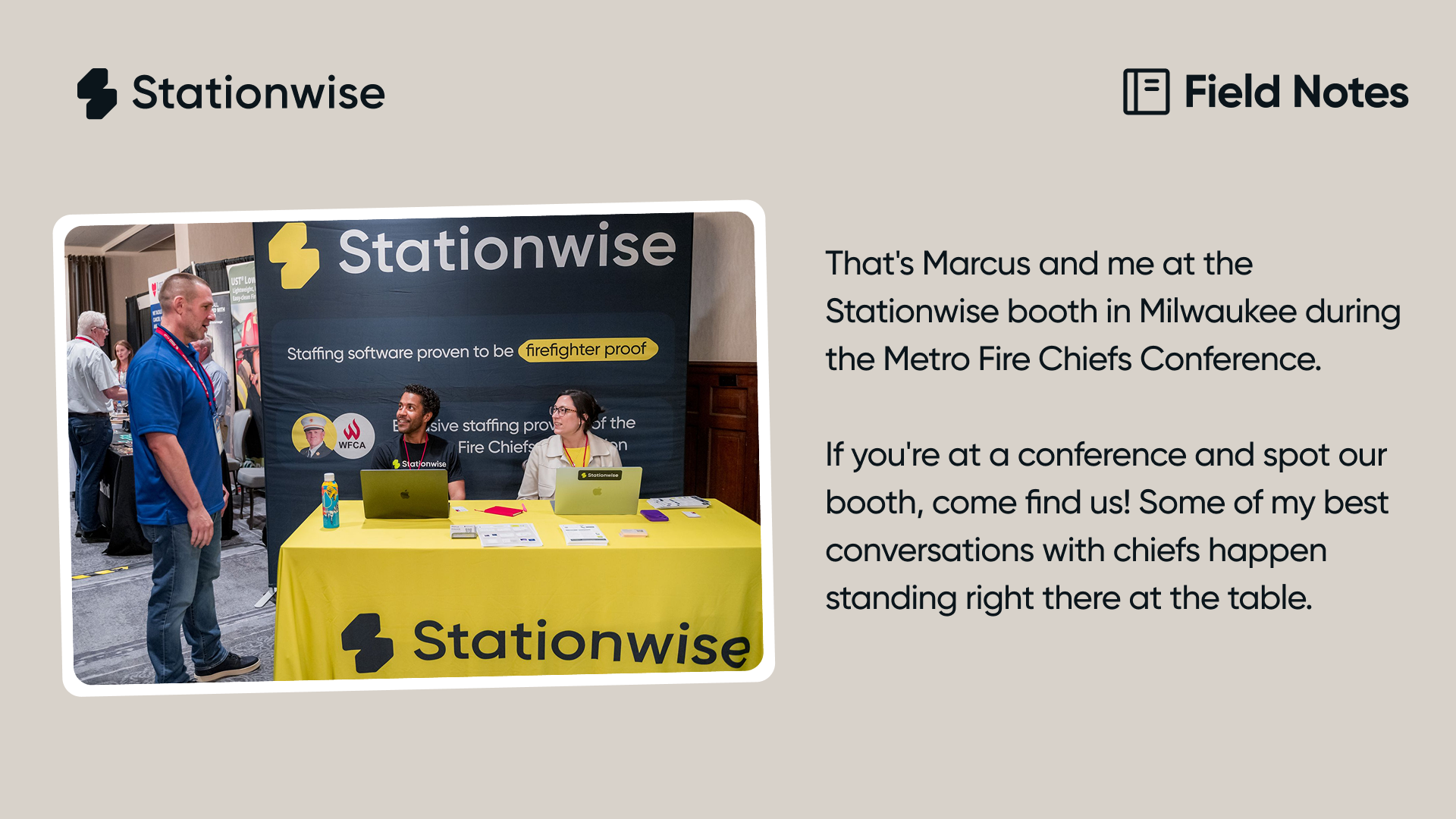



By Alissa Letkowski, Head of Sales at Stationwise
Fire chiefs are thorough buyers. By the time a fire department gets to the point of choosing a vendor, they have usually completed 10+ hours of due diligence, talked to peers at other departments, sat through multiple demos with various stakeholders, and searched for room in the budget. What’s often missing after the decision is made is the knowledge of what to do next. Navigating tech procurement processes isn't a part of their training and the vendors often don’t know where the gaps in knowledge are and where to help.
I have spent over a decade on the other side of this process, helping agencies work through government technology procurement, from sole source justifications through contract negotiation to the handoff that happens after signature. What fire departments consistently underestimate is not the decision itself – it’s everything between the decision and going live.
A fire department that has finished evaluating vendors and settled on one has done the hardest part of the emotional work. What comes next has very little to do with preference and almost everything to do with price. Every agency carries its own internal thresholds, and where a contract lands against those thresholds decides the entire path forward. Sometimes the number is low enough that a fire chief can sign directly,. Cross a certain amount and the fire department has to collect three competing quotes, even when everyone in the room already knows which vendor they want. Go higher still, and a council or board has to approve the spend before anyone can sign. Above a certain amount, some agencies are required to run a full RFP regardless of how clear the decision already is, partly because the paper trail itself is the point. A fire department needs to show it did its due diligence, even when that due diligence already happened somewhere else in the building.
Sole source justification exists to shortcut this path. If a vendor offers a specific capability that no competitor can match, an agency can document that and bypass the RFP process entirely, because putting the decision out to bid would not produce a different outcome. Fire departments tend to think of sole source as a workaround. It functions closer to an honest description of a market that has, in that specific case, already been decided by capability rather than by price.
None of these paths move faster because a fire department wants them to. What actually speeds things along is communicating the internal timeline early and getting every stakeholder who will touch the decision into the room before the process starts. A fire chief who flags a council meeting three weeks out gives a vendor time to prepare the right materials. A fire chief who mentions it two days beforehand creates a scramble for everyone involved. If your fire department is still early in the evaluation stage, the questions worth asking before you get this far are worth revisiting before you move on, since this piece picks up from where that one leaves off.
Annual price increases once the initial contract period ends are where fire departments often give away more than they realize. The industry standard is around a three to five percent annual increase. Some vendors push toward seven or eight percent, and that number tends to get buried in language that reads as routine rather than called out directly.
The figure itself matters less than what it gets calculated against. A vendor that prices per user grows that cost automatically as a fire department adds staff, which means a growing agency can end up paying for growth for which it never budgeted. This is part of why we price by battalion at Stationwise instead of by user. It holds that number steady regardless of headcount, giving an agency a predictable cost years down the line
The other structural decision worth making before signature is how much room the contract leaves for growth. A fire department that starts with a smaller initial scope, priced below its own procurement threshold, and later wants to add capability generally does not have to restart the entire procurement process if it stays with the same vendor. Expanding an existing relationship rarely triggers the same review a brand new vendor would require. Fire departments that understand this early can structure a starting contract deliberately, knowing they are not locking themselves out of adding what they need down the road.
Defining scope clearly before signature is its own discipline, and it pays to do that work well before a contract reaches a chief's desk.
One of the biggest reasons a purchase stalls after the fire admin team has already selected a vendor is that not everyone who needed to be involved in the evaluation process was involved from the start. Stakeholders that need to give input are often brought in to meet with the vendors late in the conversation, surfacing questions that reopen a decision everyone else in the room already considered settled. The fix is simple enough in theory: Every person who will eventually need to sign off, or who could reasonably raise a concern needs to be part of the conversation from the start.
IT falls into this pattern more often than fire departments expect. Fire departments tend to loop IT in near the end of procurement, after they've mostly decided. The problem is that IT always has technical questions, and answering them late can drag out timelines significantly. Get IT into the demos early and those questions get resolved before they can hold things up.
Council and board approval carries its own complexity. Vendors rarely get to present directly to a board, so the real work happens beforehand. It means giving the fire department's internal champion everything they need to make the case on their own, including the questions and objections likely to come up and the answers to both, so that when they stand in front of council they are not caught without information. A champion who walks into the room prepared moves the process forward. A champion who gets blindsided by a question nobody thought to prepare for is often the reason a vote gets tabled for another month. Your vendor should be helping arm you with the tools and collateral you need to get a “yes” the first time. Don’t be afraid to ask them to give you more.
Two other forces slow deals down that have nothing to do with paperwork.
1. Change management
A system that works well enough rarely feels worth the disruption of switching, even when everyone privately knows it is holding the fire department back, and the pain has to outweigh the friction of retraining an entire crew before a fire department will actually move.
2. Timing
Some fire departments want to switch but are still inside an existing multi-year contract with another vendor, which limits what they can do until that term runs out or until someone is willing to have the harder conversation about exiting early. Talk to the vendor you’re considering about your options.
Budget offices ask a narrower set of questions than fire departments expect, and each one is answerable if a chief has done the thinking in advance.
That last question often settles the matter. A single payroll mistake can cost far more in staff time and correction than fire departments account for when they weigh a subscription against doing nothing, and payroll errors are one of the more common places that cost hides. A chief who walks into that conversation with real numbers on all three points is making a concrete case instead of asking for trust.
A contract signature does not end the work; It changes who is doing it. The handoff from the person who managed the sale to the team that manages implementation is where a fire department's original goals are most likely to get diluted. The reason usually has nothing to do with anyone dropping the ball. It has to do with the person taking over not being in the room for the months of conversations that shaped the deal.
On my end, a clean handoff means passing along everything learned about a department during the sales process, not just the contract terms but the actual preferences, the operational nuances, and the context behind decisions that might otherwise look arbitrary to someone encountering them for the first time. The goal is for the fire department to never feel like it is starting over with a stranger. Done well, the transition is almost invisible. The fire department gets introduced to a new point of contact and keeps moving, instead of having to re-explain its own operation from scratch. Demand that level of experience from your vendor.
.png)
This works best when every stakeholder, on both sides, meets early, before the handoff happens rather than after. A fire department that gets its implementation team and its internal stakeholders in the same room before the transition keeps the thread of what it actually needs intact. That thread is easy to lose the moment ownership changes hands, and once it is lost, fire departments end up relitigating decisions they thought were already settled. The relationship a fire department has with its vendor does not end at signature, and how that relationship holds up over time often traces back to how well this handoff went.
The mistake I see most often is not unique to fire departments, though it shows up there in a particular way. It is failing to get the right people in the room early enough. A staffing platform touches nearly every role in a fire department, from the chief signing the contract down to the payroll administrator processing pay codes and the battalion chiefs running crews day to day. Fire departments that bring all of those perspectives into the demo and evaluation process from the start tend to move through procurement with far fewer surprises later. Fire departments that treat this as a single person's decision are usually the ones relitigating it after the fact, either during procurement or after go-live, when someone who was never consulted finally sees what was actually bought.
Government procurement is not designed to move fast, and no amount of preparation changes that, but a fire department that understands the shape of the process before it starts, and brings the right people into the room early, moves through it with far less friction than one that treats each stage as a surprise. The chiefs I have worked with who came out of this process in the strongest position were rarely the ones with the simplest contract. They were the ones who understood what they were walking into before they started, and if your fire department is somewhere in that process right now, I would rather walk you through it directly than have you piece it together on your own. Book a time with me, and we can talk through exactly where you are and what the next step actually looks like.