


The best fire department scheduling software depends on department size and staffing complexity more than brand familiarity. Stationwise leads for full-time and combination departments that need staffing automation built around real FLSA and union pay code logic. UKG TeleStaff remains a strong fit for departments already running other UKG products for HR and payroll. Vector Solutions fits agencies that want scheduling bundled with certification and training tracking through TargetSolutions, and eSchedule fits smaller departments that want proven, dependable scheduling without paying for complexity they don't need.
Stationwise builds staffing software for fire departments, and that shapes which platform this comparison ultimately favors. It doesn't change the standard applied to get there. Every claim made here about another vendor comes from that vendor's own public materials, independently verified customer reviews, or a documented account from a department that made the switch, and reflects the most current information available as of publish date. A chief comparing options deserves an honest accounting of every one of them, ours included.
Fire department scheduling carries a layer of complexity that generic workforce tools were never built to handle. Firefighters typically work under FLSA Section 7(k), a provision that lets public safety employers use a longer work period, often 28 days, before overtime calculations apply, rather than the standard 40-hour week most scheduling software assumes. Getting this wrong creates more than an accounting headache. It creates real compliance risk and grievance exposure with the union. DOL Fact Sheet #8 lays out the specific thresholds, and a platform built for retail or office shift work will get this calculation wrong before it gets anything else right. Stationwise's own guide to FLSA firefighter overtime walks through how 7(k) periods actually work in practice.
Pay code volume builds up the problem. According to Stationwise CEO Marcus Edwards, fire departments account for more than 80 percent of a city's total pay codes, covering acting pay, specialty certifications, hazard differentials, and dozens of categories that rarely apply anywhere else in municipal government. A scheduling tool that can't automate pay code assignment at that volume pushes the work back onto a battalion chief or payroll admin, one shift at a time, which is exactly how payroll errors build up in fire departments.
Shift pattern terminology adds another layer that vendor materials written without direct fire service experience often get wrong. A Kelly day is an extra day off built into certain 24-hour rotation patterns to bring average weekly hours down to a target number. A debit day, used mostly in the Pacific Northwest under 24/72 patterns, works in the opposite direction, adding a work day to bring average hours up. Stationwise's breakdown of 24/48 versus 48/96 patterns covers how these patterns actually affect a department's staffing math.
None of this is optional context. It's the baseline any scheduling platform needs to clear before size, price, or interface become relevant questions, and it's worth keeping in mind through every vendor section that follows.
Seven platforms come up again and again once a fire department starts comparing options seriously, and each one gets an honest accounting here, including where it may genuinely be the better fit for a given department.
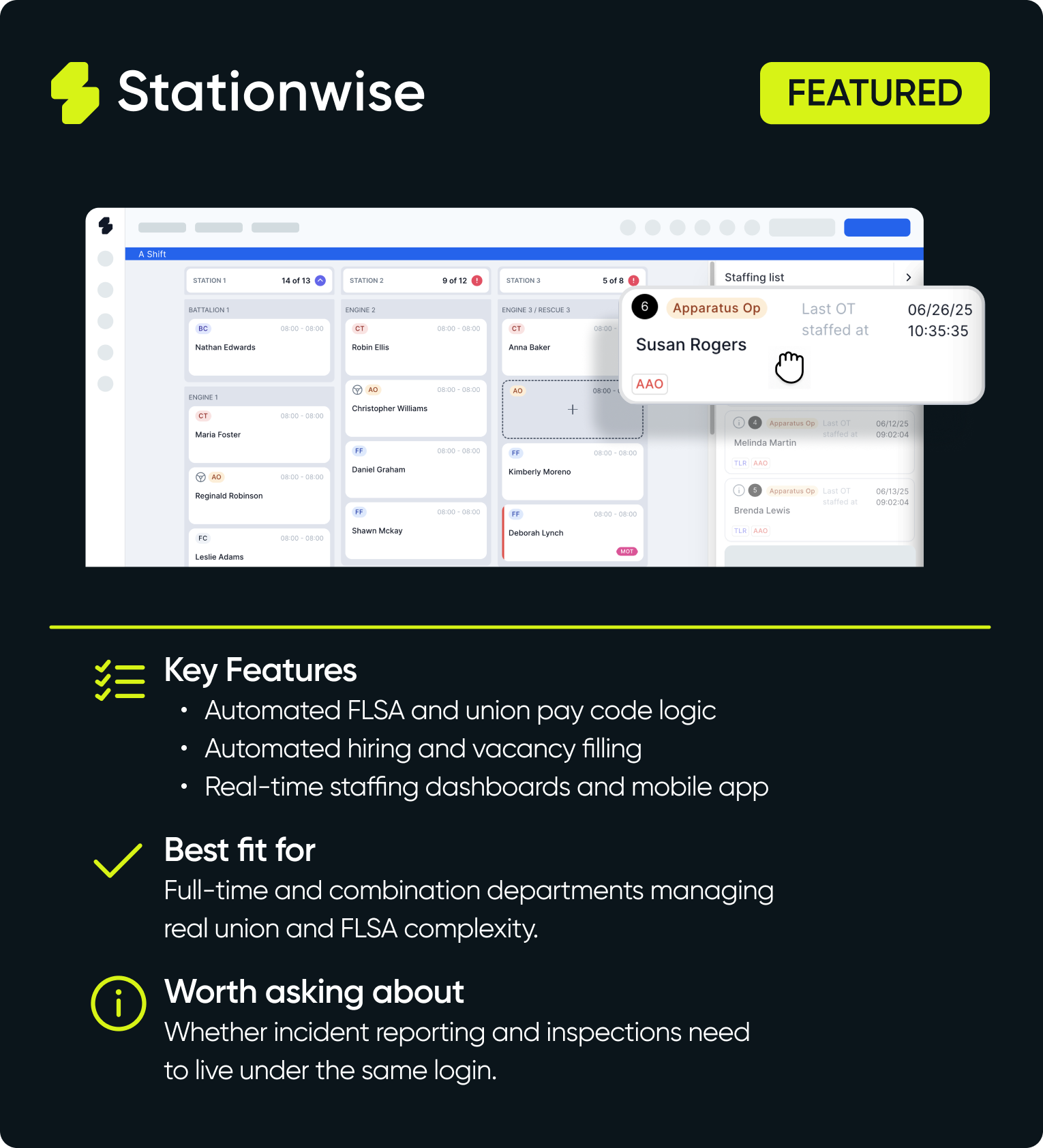
Stationwise is built exclusively for fire agencies, not adapted from a generic government or public safety platform. It prices by battalion rather than per user, so costs stay predictable as a department grows rather than climbing with every new hire. Pay code assignment runs on automated rules built around FLSA 7(k) and union agreements, and onboarding is handled entirely by Stationwise's own team rather than left to department IT.
Fresno County FPD replaced its legacy staffing software after the platform couldn't accommodate the department's new 66-hour workweek. Stationwise built a custom pattern editor to handle it. Battalion Chief Brandon Markle said, "That's what we love about you guys, everyone gets back to us really quick. With our last staffing software, it could be four days before we even hear anything."
McKinney Fire Department replaced its legacy scheduling software and now runs real-time integration between its roster and its ESO incident reporting system. Battalion Chief Pieter Wasserman called Stationwise "lightyears ahead of every other staffing tool in the industry."
Eagle Fire Department, a fast-growing department in Idaho, replaced its legacy staffing software partly to escape unpredictable costs as the department expanded. Battalion Chief Ben Rosenbaum said, "Change in the fire service is always brutal. But now that everybody's getting used to Stationwise, they're enjoying the experience a lot more than our last staffing platform."
Stationwise is built specifically around staffing, scheduling, and payroll rather than the full range of fire department operations. A department comparing options here is really weighing how much value comes from that focus against wanting incident reporting and inspections under the same login, a genuine fit question that depends on whether a department already has a records system in place or is looking to consolidate everything into one platform.
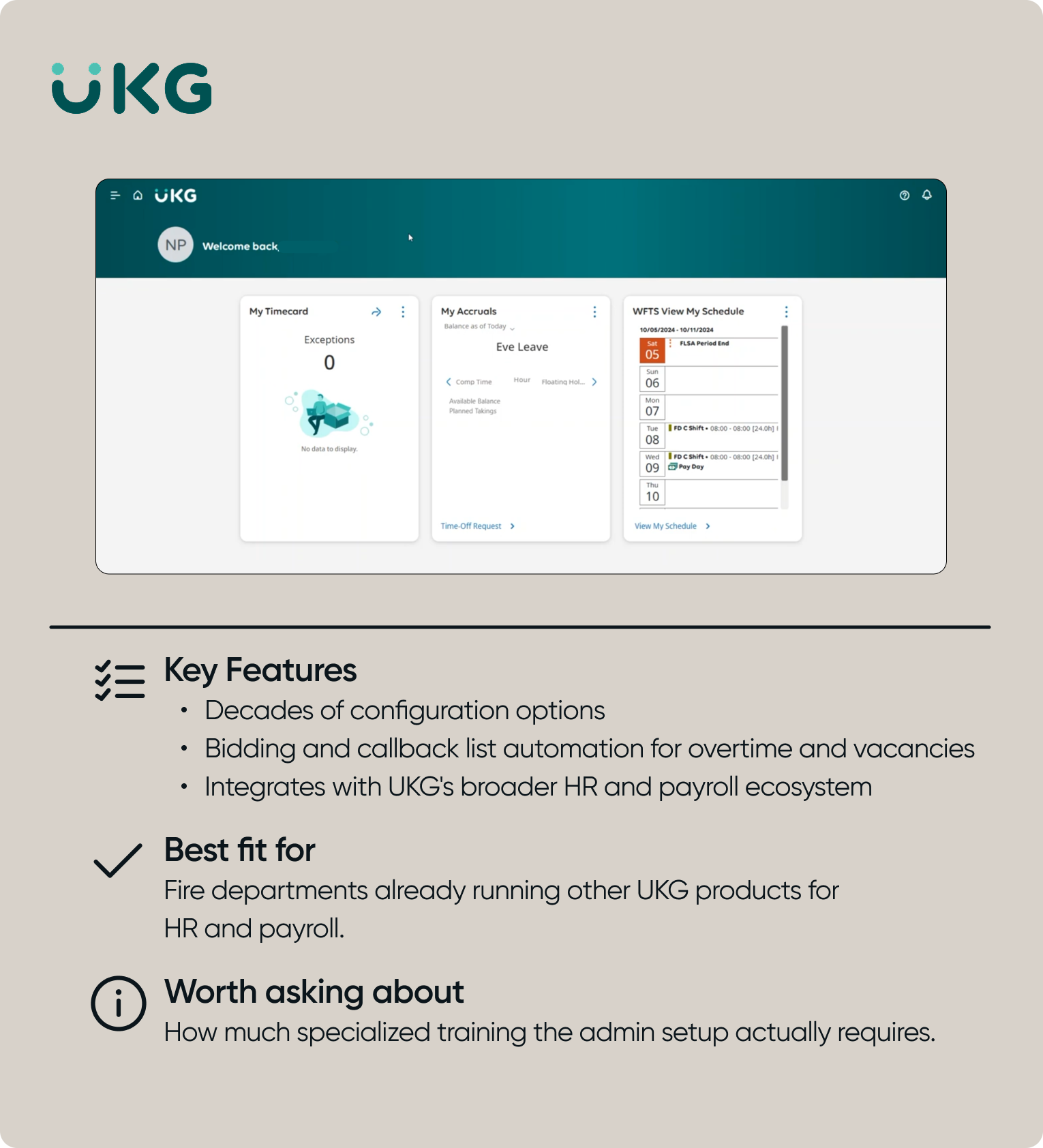
UKG TeleStaff is the most established name in fire and EMS scheduling, with a track record spanning more than three decades and deployments across departments nationwide. That much time in the field means the platform has had years to build out edge cases many newer tools haven't encountered yet, complex bidding structures, seniority-based auctions, and union rules that vary from department to department. It's a strong fit for departments already running other UKG products for HR and payroll, since scheduling data flows into the same ecosystem rather than needing a separate system to reconcile. Its long history in the fire service also means many longtime users already know their way around it, with one Fire Captain on Capterra describing it as widely used throughout the fire service.
Getting the most out of that configurability rewards a department willing to put real time into initial setup, particularly one already comfortable with UKG's broader systems, since the underlying logic tends to carry over.
First Due
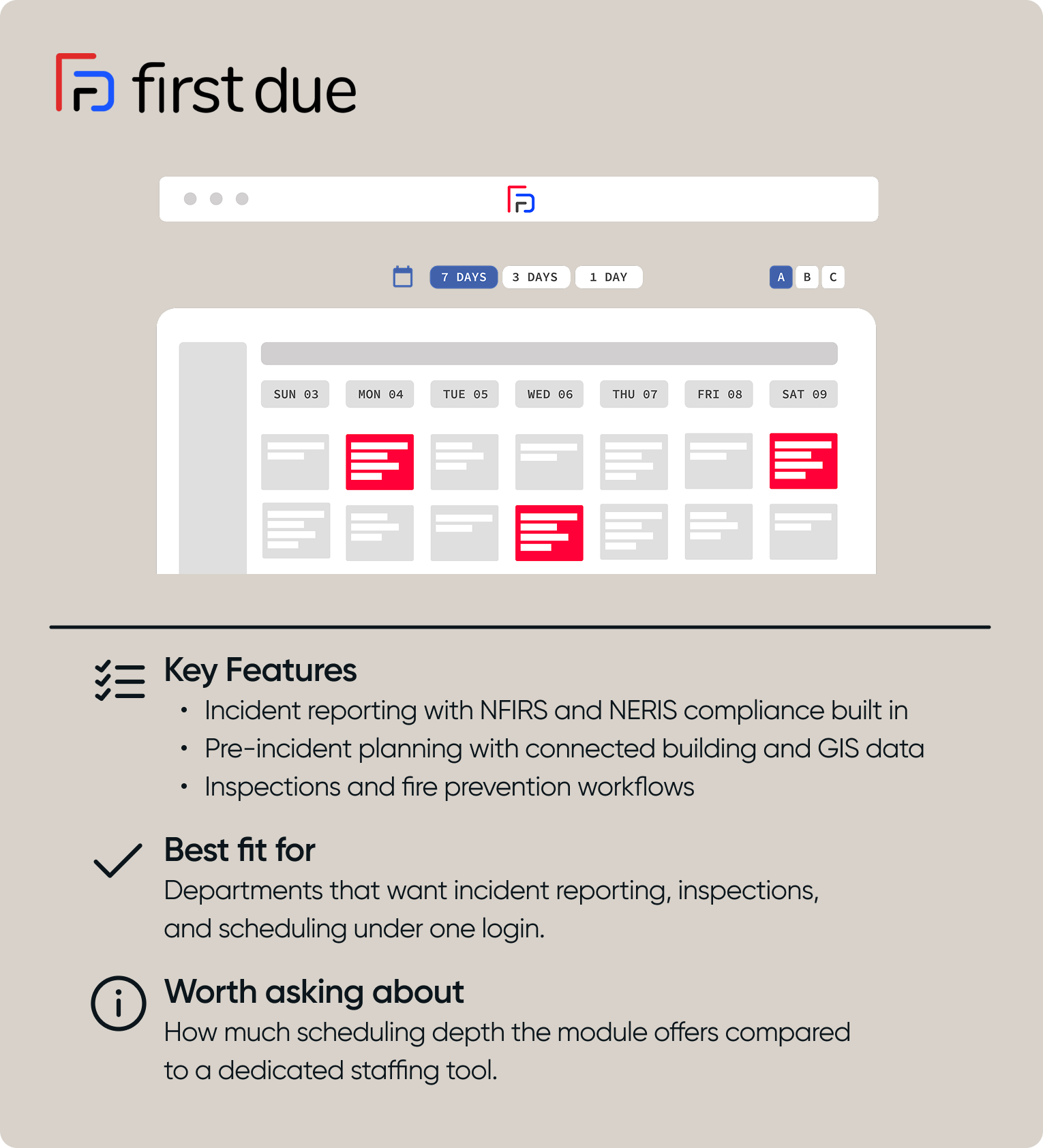
First Due is a full fire and EMS operations platform covering incident reporting, inspections, pre-incident planning, and scheduling under one login. That range comes with real depth behind it. NFIRS and NERIS compliance is built directly into incident reporting, pre-incident planning connects to live building and GIS data, and inspection workflows are built specifically for fire prevention rather than adapted from a generic municipal tool. For departments trying to consolidate several disconnected systems into one, that combination is the entire appeal, and public reviews consistently praise its fire-service-specific support staff and overall customer service.
Scheduling sits inside that platform as one module among several, built to work alongside incident reporting and inspections rather than stand alone as a dedicated staffing tool. The tradeoff comes down to breadth versus specialization, consolidating everything under one login against getting scheduling-specific automation from a platform built around staffing alone.
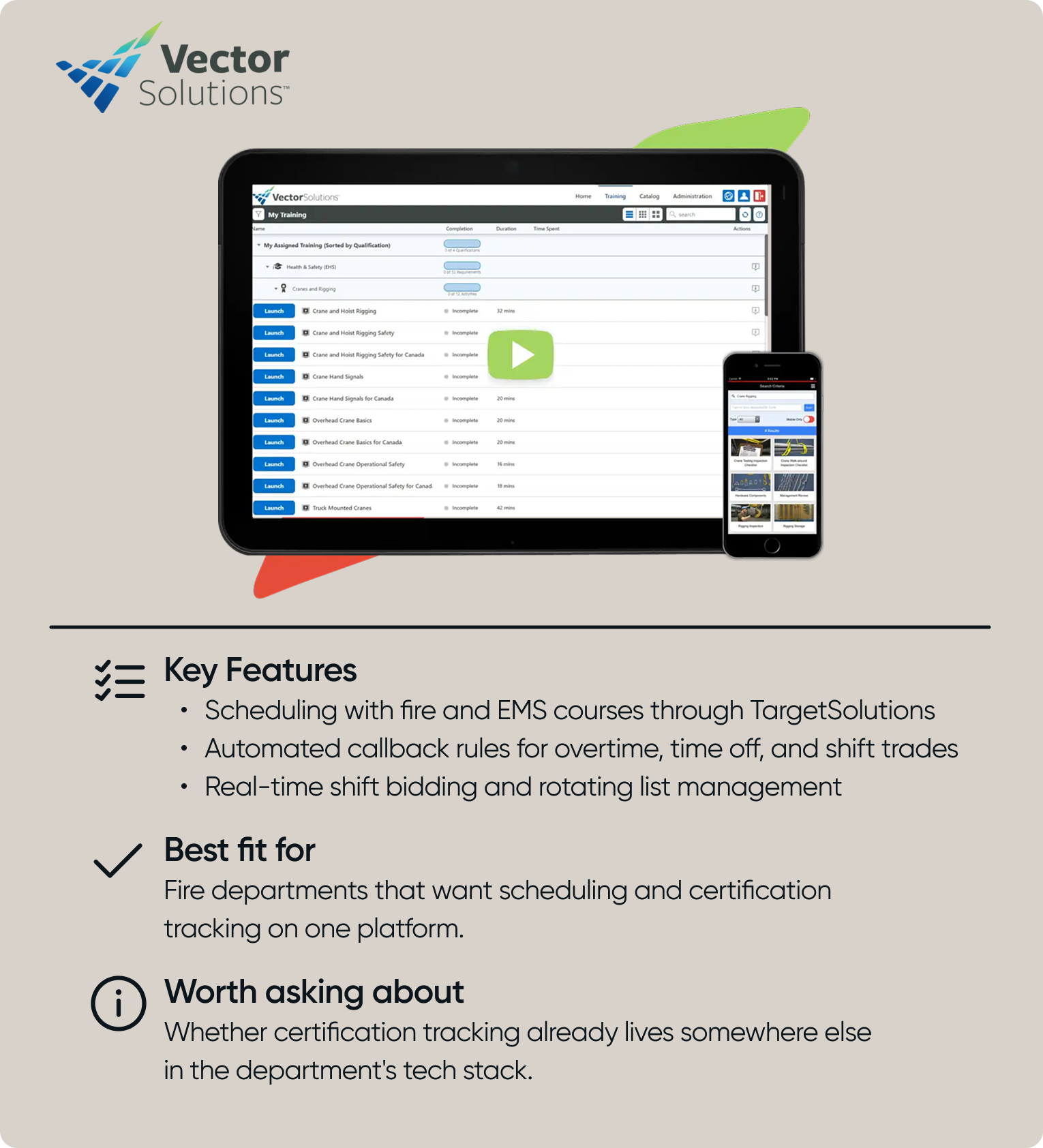
Vector Solutions, known as CrewSense before a 2019 acquisition, bundles scheduling with an extensive fire and EMS training content library through TargetSolutions. For departments that want scheduling and certification tracking under one platform, that combination is a real advantage few competitors can match. Automated callback rules handle overtime, time off, and shift trades, and certification tracking ties directly into state credentialing and NFPA compliance requirements, keeping training records and shift assignments in the same system instead of two separate ones.
A department comparing options here is really weighing how much value that training-and-scheduling bundle adds against a platform built around scheduling alone, a genuine fit question that comes down to whether certification tracking already lives somewhere else in a department's tech stack.
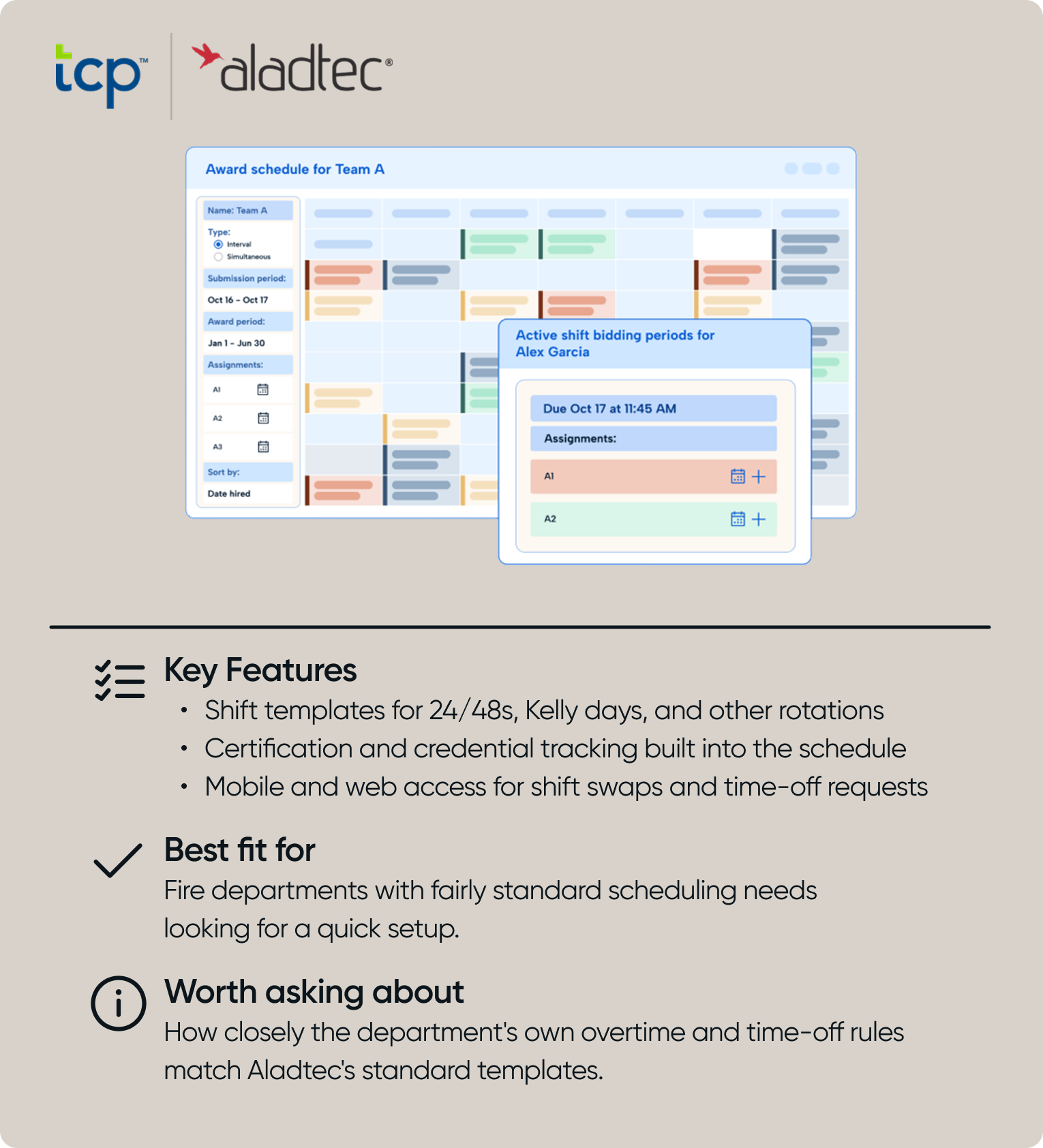
Aladtec has served public safety agencies since long before most competitors on this list existed, and it comes with a mature library of shift pattern templates covering 24/48s, Kelly days, and other standard public safety rotations, which shortens setup for departments with fairly typical scheduling needs. Certification and credential tracking is built directly into the schedule rather than living in a separate system, and shift swaps and time-off requests can be handled from mobile or web without needing to call anyone in.
The closer a fire department's scheduling patterns already match those standard templates, the less custom configuration its overtime and time-off rules will need going in. That match matters more here than almost anywhere else on this list, since Aladtec's value rests heavily on how well its defaults fit a fire department's existing rules.
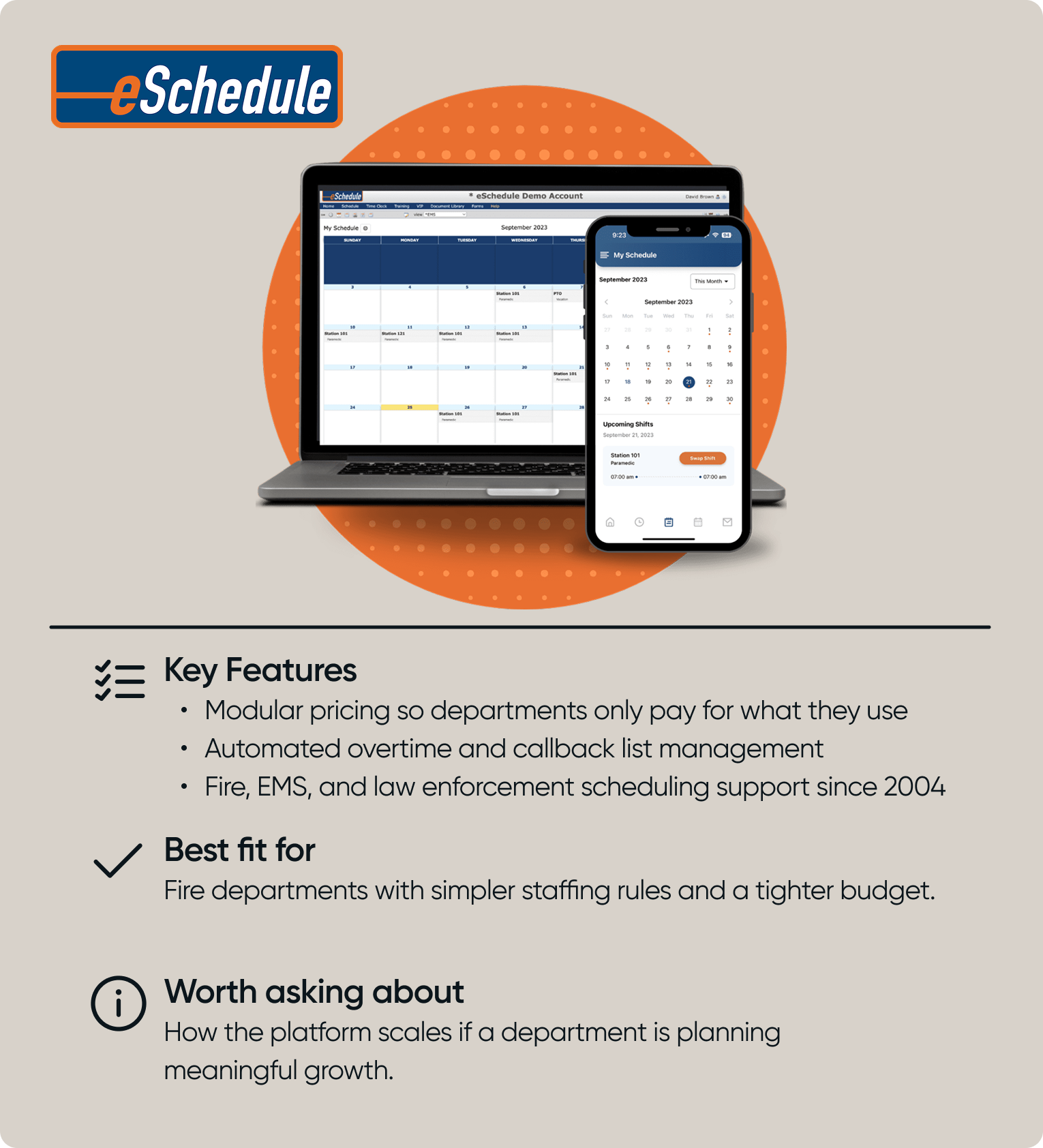
eSchedule has served fire, EMS, and law enforcement agencies since 2004, longer than nearly every other platform on this list, and it remains a genuinely strong option for smaller departments working with a tighter budget. Its modular pricing model lets departments pay only for the pieces they actually need, and reviews on Capterra consistently praise its customer service.
A department planning to stay roughly this size for the next several years gets a genuinely well-matched, affordably priced tool. One expecting meaningful growth should ask how the platform scales before signing a multi-year agreement, since that's the point where modular pricing and simplicity tend to get tested.
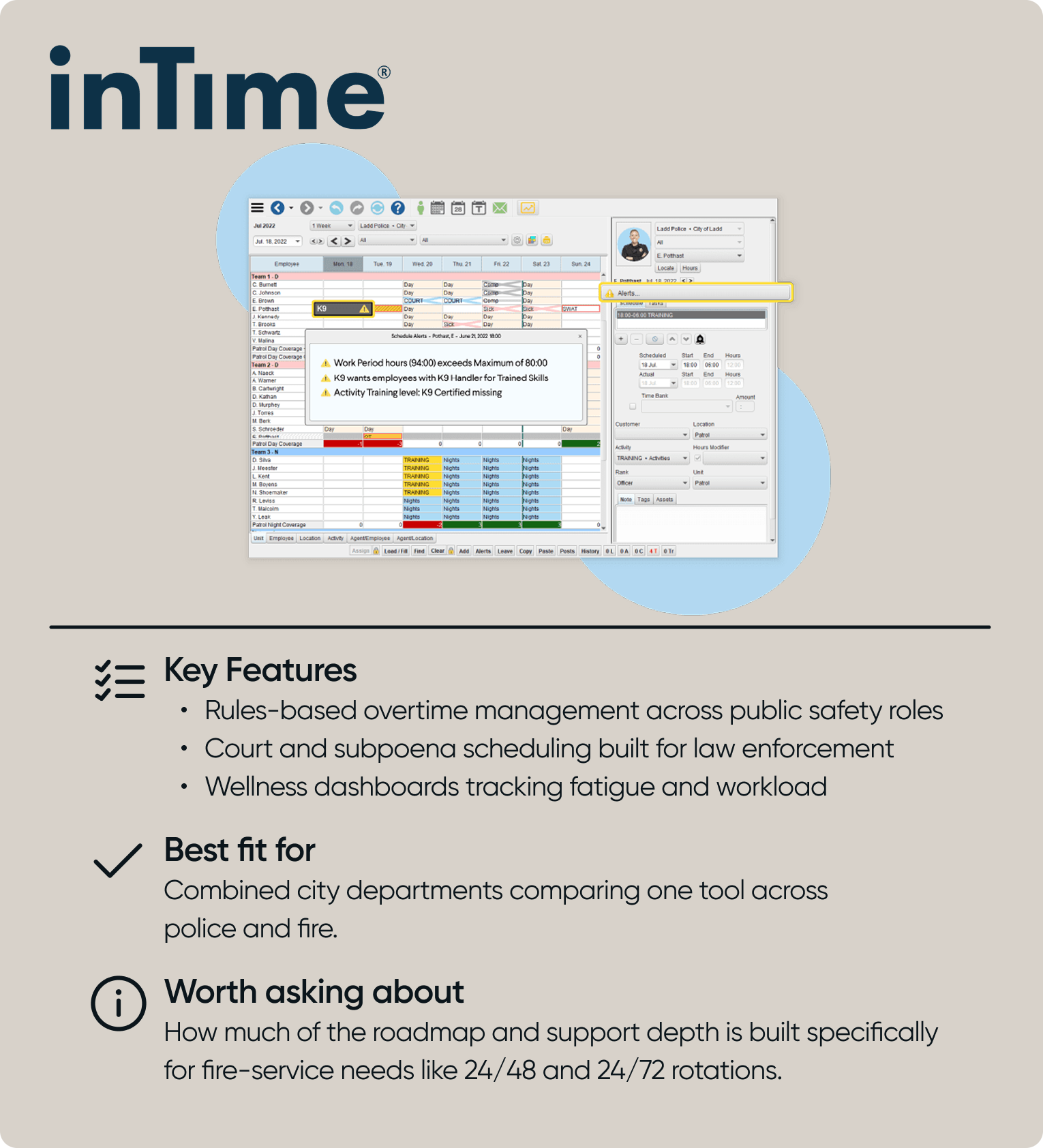
InTime provides scheduling software across public safety, including police, fire, corrections, and dispatch, and maintains a dedicated fire department product page and case studies alongside its broader public safety materials. Its overall case study library and market presence still lean more heavily toward law enforcement, so a fire department evaluating it should ask how much of its roadmap and support depth is specifically built around fire-service needs like 24/48 and 24/72 rotations.
It's a solid choice for combined city departments comparing one tool across police and fire. A fire department evaluating scheduling software on its own may still want to weigh it against the fire-first options above.
Feature lists make every one of these platforms look similar on paper. What actually separates them shows up in four places once a department starts using one day to day.
Pricing model matters more than the sticker price. Per-user pricing looks affordable at signing and becomes expensive exactly when a department is growing and adding staff, the moment it can least afford a cost increase. Battalion-based and flat-rate pricing structures hold steadier over time, which matters more for a five-year budget cycle than a first-year quote does. What a firefighter work schedule actually costs a department goes deeper into how these costs accumulate.
Support reality rarely matches what gets promised in a sales conversation. The clearest line between departments that stay happy with their vendor and departments actively looking to leave is how long it takes to get a real answer when something breaks. A same-day response and a same-week response are functionally different products, even when a contract calls them the same support tier.
Payroll depth is where most of these platforms quietly fall short. Nearly every vendor covered here relies on CSV exports or periodic file feeds to move data into payroll rather than a direct, real-time sync, which means someone on staff is still reconciling hours by hand somewhere in the process. A platform that can't automate FLSA 7(k) and union pay codes at the point of scheduling is asking a payroll admin to catch every error after the fact instead.
Migration handling determines how painful the first ninety days actually are. Departments that switch platforms are trusting a vendor with years of historical roster, certification, and payroll data, and the ones that make that transition well are the ones doing the setup work themselves rather than handing a department a blank system and a login.
None of these platforms are interchangeable once the surface-level features get set aside. The right one depends on department size, existing procurement constraints, and how much staffing complexity actually lives inside a union contract. A department that asks every vendor the same four questions, how pricing holds up as the department grows, how fast support actually responds, how deep payroll automation really goes, and who does the work of switching, gets a clearer answer than any feature comparison chart can provide. For a deeper walkthrough of that evaluation process, 7 Questions to Ask Every Fire Department Staffing Software Vendor and How to Define Scope Before You Sign with a Fire Department Software Vendor both cover it in more depth.
The vendor unwilling to answer plainly on those four questions has already answered the one that matters most.
Stationwise works exclusively with fire departments on staffing, scheduling, and payroll. Book a demo to see how it handles your department's specific rules.
Fire departments use a mix of purpose-built staffing platforms and broader public safety software with scheduling built in. Common options include Stationwise, UKG TeleStaff, First Due, Vector Solutions, Aladtec, and eSchedule. The right fit depends on department size, budget, and whether scheduling needs to stand alone or connect to incident reporting and payroll.
Pricing varies by model more than by vendor. Per-user pricing can look affordable at signing and rise as a department adds staff. Flat-rate or battalion-based pricing holds steadier across a multi-year budget cycle. Smaller departments with simpler staffing rules can often find modular, budget-tier options starting in the low thousands per year. Departments with heavier FLSA and union complexity generally need a more automated platform regardless of the initial quote.
Scheduling software manages staffing, shift patterns, overtime, and payroll integration. A fire RMS, short for records management system, handles incident reporting, NFIRS and NERIS compliance, inspections, and pre-incident planning. Some platforms bundle both under one login. Others, including Stationwise, focus exclusively on staffing and payroll and integrate with a separate RMS for records. The right structure depends on whether a department wants a single vendor or the deepest possible tool in each category.