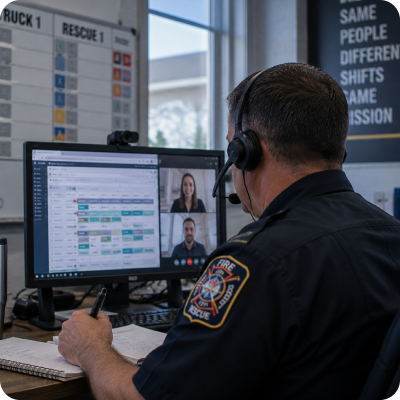



What is white glove onboarding, and what does it actually mean for a fire department replacing legacy tools? The phrase describes a high-touch approach to getting a new customer live. A dedicated team handles data migration and configuration, walks the customer through setup and training, and stays hands-on until the transition is complete.
It's a term common across B2B software generally, and it shows up in fire service software too, without much specificity behind it beyond the phrase itself. Here is what it actually looks like in practice, using Stationwise's own process for replacing a legacy staffing tool.
.png)
Fire chiefs who've lived through a failed technology transition point to the same moment, the handoff from the sales team to the people who actually build the system. The sales team is often the most energized group a fire department meets from any vendor, and that energy doesn't automatically carry over to whoever shows up after signing. A second handoff often follows, from implementation to ongoing support. Meeting the implementation team before signing, something A Fire Chief's Guide to Getting the Vendor Relationship Right covers in more depth, is the clearest way to know whether onboarding promises will hold up once the contract is signed.
Stationwise's onboarding starts with the fire department assembling a working group to represent it through the transition, typically within the first 1 to 2 weeks. A working group built only from command staff configures the system for how command staff sees things. The battalion chiefs running callouts and the firefighters logging in from a phone find out what's missing after go-live.
Chief Paul Dow's approach at McKinney Fire Department mixed admin and operations from day one, because a battalion chief and a firefighter need different things from the same staffing system.
The heaviest lift in any staffing software transition is migrating what already exists. Stationwise logs into the outgoing system, pulls the reports, and imports the data directly, then runs a short survey with the fire department to capture the rules a data export won't show. That covers staffing lists, seniority order, pay and work codes with their legacy exceptions, planned time off, and shift trade history. The fire department's role is verification, checking the imported data against what they already know to be accurate.
Battalion chiefs and staffing officers work 48 to 96 hour shift rotations, which leaves little room in the schedule for administrative data entry. Handing a fire department a spreadsheet template and a login is not white glove onboarding, whatever a sales deck promises.
This phase is also where pay code simplification tends to happen. Fire departments often carry more pay code complexity than their rules actually require, built up from years of small workarounds. According to our CEO Marcus Edwards, Stationwise can often reduce a fire department's pay code count by 20 to 30% during onboarding.
Once the data is in, the next phase is proving it's right. Stationwise runs the outgoing and incoming systems side by side for 4 to 6 weeks before cutover, testing real scenarios instead of a single clean payroll cycle. This overlap period is where a payroll problem gets caught before it reaches a paycheck instead of after. Testing covers holiday pay, an employee on light duty, a Kelly day landing across a pay period boundary, and unusual shift trade sequences, the situations that break a careless migration.
A signed contract usually names a go-live date. Three milestones matter more. All data and rules get loaded into the new system, and the working group verifies them. Every known blocker gets resolved instead of deferred. One to three payroll cycles run clean and get signed off before the fire department fully cuts over. How to Define Scope Before You Sign with a Fire Department Software Vendor makes a similar case for go-live generally, defined separately for scheduling, payroll, and the frontline user rather than treated as one date on a calendar.
.png)
The working group and battalion chiefs train first, within a 2 to 4 week window, confirming the configured rules match how the fire department actually runs. Everyone else trains within 1 to 2 weeks, once the people closest to the rules have verified them. Ben Rosenbaum, Battalion Chief at Eagle Fire Department, put it plainly after Eagle's own transition to Stationwise. Change in the fire service is always brutal, and people ended up enjoying the new system more than the old one once they got used to it. Stationwise builds and maintains the training materials, not the fire department.
The old system shutting off looks like the finish line. Fire department rules keep changing after that. Union contracts get renegotiated. New pay codes get added years later when a specialty assignment didn't exist at go-live. Stationwise keeps a live product roadmap that fire departments can see and add requests to directly, so a rule change or a new configuration need doesn't disappear into a support queue. Configured rules stay documented, changes get flagged as they happen, and training materials stay current, so a new administrator two years from now isn't calling support to ask a question the fire department already answered once.
At Stationwise, "white glove onboarding" means naming who touches the data, how long each phase runs, and what gets tested before cutover, in specific and checkable terms. A fire department that knows those specifics going in gets the transition it was promised. One that takes the phrase on faith risks spending its first year fixing what should have been caught before go-live.
See how Stationwise structures this process for your fire department. Book a demo.