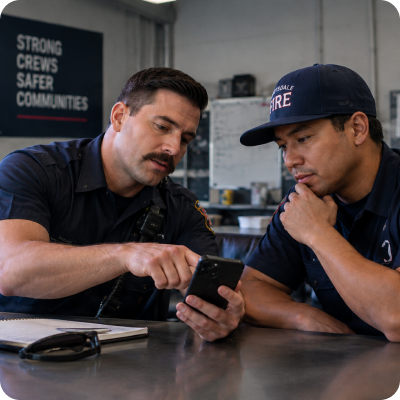



A firefighter schedule app puts a fire department’s staffing on members’ phones. Crews use it to see their schedule, answer overtime offers, trade shifts, request time off, check accrual balances, and review timecards. Admins use it to fill vacancies, approve requests, and keep a record of every staffing decision. The value shows up on days off, because firefighters on 24-hour and 48-hour rotations are off duty on most days of the calendar.
Firefighters on these rotations work one long shift and then go home for two or more days. Each rotation, from a 24/48 to a 48/96, keeps members off duty on more days than on duty.
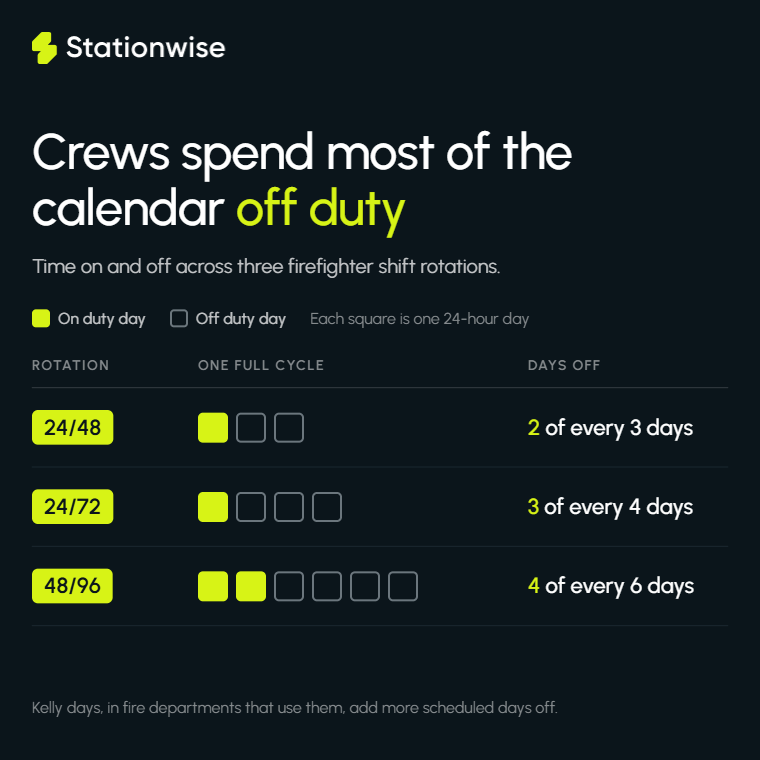
Kelly days, in fire departments that use them, add more scheduled days off to the rotation.
A callback goes to members who are off duty. On a 24/48, that’s two of the three shifts on any given day, and on a 24/72, three of the four. Overtime offers, trade requests, and approvals all reach members wherever they happen to be, which on these rotations is usually away from the station. Reaching them takes something they carry, and Pew Research Center’s 2026 survey found that 91% of U.S. adults own a smartphone.
In a firefighter schedule app, an overtime offer arrives as a text or push notification with a link to the open position. The member opens the link, sees the positions they’re eligible for, and signs up from wherever they are. The app can also close an offer once the position fills, so no one signs up for a seat that’s already taken.
Federal rules decide how a shift trade counts toward overtime. Under 29 CFR 553.31, two employees of the same public agency can trade shifts during scheduled work hours, and the hours the substitute works stay out of their overtime calculation when three conditions hold.
A trade requested and approved in the app puts that approval in writing before the shift, with both names and the date attached. The app can also limit trade partners to members qualified for the position, so every traded seat stays filled by someone certified for it.
Members can look up their position on a staffing list for any future date before deciding whether to keep that day open. They can also follow each time-off or trade request through approval and see who still needs to sign off.
Members can see their accrual balances before requesting time off, then review timecards and sign them where the fire department requires a signature.
Fire departments that use the FLSA 7(k) exemption can set a work period anywhere from 7 to 28 consecutive days, and the work period doesn’t have to match the pay period. Under 7(k), FLSA overtime applies after 212 hours in a 28-day work period or after 106 hours in a 14-day work period, according to DOL Fact Sheet #8. A firefighter schedule app that shows hours by both pay period and work period lets members check their own hours against the period that sets their FLSA overtime.
The IAFF wrote in 2025 that there is no simple answer yet to firefighter sleep deprivation, because the data still isn’t sufficient. Asst. Chief Mike Binney studied what interrupts firefighter sleep at West Metro Fire Rescue in Colorado as part of his graduate work at Yale University. The study tracked 197 of the fire department’s firefighters with wearable devices and questionnaires over a few weeks. Asst. Chief Binney found that apparatus assignment mattered, with ambulance personnel interrupted the most and truck companies the least, and that call volume and call length were also factors.
Days off are when crews recover from shifts like these. A firefighter schedule app lets the fire department choose which message types go out by text, push notification, or email. Urgent overtime offers can reach members right away, and routine notices can wait in the app until members check it.
A firefighter schedule app can send an overtime offer to every eligible member at the same time, or work through the list one member at a time in the order the fire department’s rules require. Either way, the system sends each offer and tracks each response.
Officers and admins can approve time off, shift trades, and extra hours from a phone. A request moves forward without waiting for the approver to get back to a station computer, and the member sees the decision as soon as it’s made.
The app logs who received each offer, when it went out, and whether the member accepted or declined, along with every approval and roster change. When anyone asks how the fire department filled a shift, the answer comes with names and timestamps from the same system that checks eligibility before an offer goes out.
Pew’s figure also leaves 9% of U.S. adults without a smartphone. The app should fall back to email or an automated phone call for any member who doesn’t carry one, so every eligible member still receives every offer.
Each of these benefits depends on a specific feature, and a fire department can test every one in a vendor demo.
A simple test is to hand a firefighter the phone during the demo and have them complete a shift trade, a time-off request, and a timecard signature. These checks belong alongside the 7 questions to ask every fire department staffing software vendor.
Stationwise covers each of these features in one app across phone, tablet, and desktop.
Firefighters on 24-hour and 48-hour rotations spend most days away from the station, so the system that runs staffing has to reach them there. A firefighter schedule app gives crews control over offers, trades, time off, and hours, and gives admins approvals from anywhere with a record of every offer behind them.
Book a demo to see how Stationwise handles your fire department’s staffing rules on the phone.